
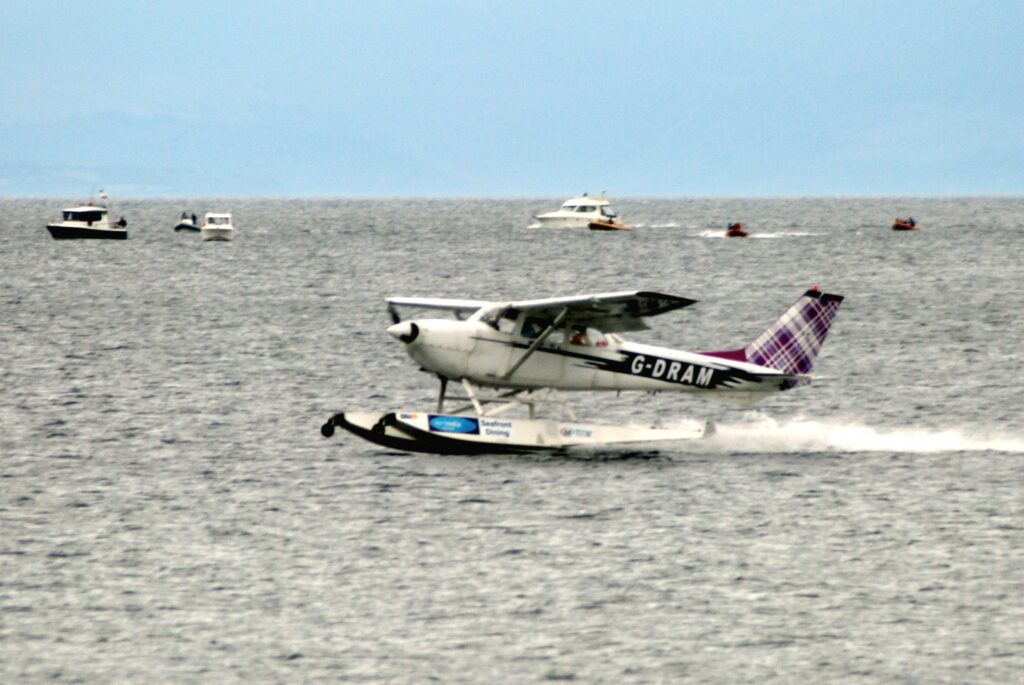
Although another single-engine floatplane, Prestwick-based G-DRAM is a very different machine from the AT-802F photographed in Portugal. The Cessna 172F (the ‘F’ stands for floatplane) was built at Cessna’s Rheims plant in France and delivered as OH-CNS in 1969. Operating in Finland, the land of lakes, the Rheims Rocket was valuable for water-based operations as well as parachute flights. The 4-seater has a 2-hour endurance and is powered by a conventional Continental HP210 engine. The current floats are Wipline 2350 units which have been fitted in place of the original Edo 2440b floats.
On September 18th 1998, the Cessna moved south to join the Off Water Group on the west coast of Scotland. The ownership moved to another flying group, Clyde River Rats, on 25th January 2001 with a single trustee listed as the owner until 2007 when ownership was nominally split between two further trustees, one of which is the current owner Hamish Mitchell. The Cessna’s home base was listed as Prestwick on March 2nd 2011 when G-DRAM’s ownership passed to Hamish Mitchell as the sole owner.
G-DRAM is a frequent sight in the skies above Ayrshire and Dumfries & Galloway and has appeared at many of the recent flying displays at Ayr. The owner works at the Scottish Air Traffic Control Centre and operates this most-Scottish of floatplanes from the Prestwick Flight Centre. As well as the ‘Dram’ registration and the recent addition of a tartan-patterned tail fin, the Cessna carries ‘Spirit of Scotland’ titles on the floats. G-DRAM has also spawned its own Flight Sim ad-on to the Microsoft Cessna 172 module and often appears in film and TV dramas filmed in Scotland.
Operated under the name of Scotia Seaplanes, G-DRAM is also used for both seaplane safaris north to Oban and Mull and for floatplane instruction, often on Loch Doon and Loch Trool in Galloway as well as Loch Awe. Chris Gotke, the Royal Navy pilot scheduled to fly the Supermarine S5 replica, received tuition on G-DRAM as he learned the finer points of floatplane control. G-DRAM’s undercarriage comprises the floats with individually-steerable main wheels and a caster wheel at the front plus a rudder at the back of each float. The rudders are, of course, only used while taxiing on water. Selecting the correct undercarriage configuration is certainly critical, making the wrong choice is guaranteed to ruin a pilot’s day! To assist, there are four indicator lights in the cockpit, blue for touching-down on water, green for land. The float-equipped Cessna has many handling features similar to a tail-dragger and a floatplane endorsement takes around 8 hours of training. The curriculum also involves a seamanship exam to cover some of the unique features of seaplane flying.
G-DRAM’s marine career has not been without Dram-a: on May 1st 1999 she was damaged at Loch Diabaigas Airde and, eighteen years later, in May 2017, a port undercarriage wheel collapsed during landing. Both instances illustrate potential floatplane hazards. The 1999 accident occurred during a water take-off from the loch, which is close to Loch Torridon. The plan was to taxi downwind, westwards across the 500m wide loch before making a 180 degree turn and starting the take-off run, moving from nose-up plough taxiing to hydroplaning on the float step and taking-off to the east. The pilot was accustomed to a Piper Cub floatplane, which can turn more tightly than the Cessna, and his 180 turn was too wide. Despite shutting-down the throttle, G-DRAM strayed into an un-surveyed area of water and hit a submerged rock. The floats were damaged beyond repair and the underside of the fuselage was distorted. This is probably when the Edo floats were exchanged for the Wipline units.
The second incident occurred during a second flight following a period of maintenance. The pilot observed that the engine was running rough, possibly owing to a fouled spark plug, and broadcast a PAN call requesting a priority landing at Prestwick. After a smooth landing, the Cessna traveled around 50 metres before the left main landing wheel retracted into the float causing the aircraft to veer to port and halt on the runway margin. When the Cessna was lifted by a crane, the wheel descended suggesting that it might have not locked into place properly prior to landing.
Hopefully, G-DRAM will avoid any further accidents and incidents and will continue her operations on the west coast of Scotland. On April 25th 2025, G-DRAM had completed 6063 flying hours, an increase of only 116 hours from October 2023.
Sources: Air Safety Network, the CAA site G-INFO, Flyer.co.uk for August 2021.
Hits: 415