
I have discovered that, for an aircraft I have always admired, I know very little about Harvards. There are, however, many links to the trainer in other Miscellavia threads: preserved examples in Spain, service with the South African Air Force, insurgent operations in Biafra and Gary Numan’s Harvard flights from Earls Colne airstrip. So let’s look at a brief history of the type after an appreciation of WW2 veteran G-BDAM.
G-BDAM was built in 1943 as a Harvard IIb at Noorduyn’s Cartierville factory in northern Montreal. It was originally constructed as an AT-16 to become 42-12479 with the USAAF but delivery never took place and, on 26/4/43, joined the RCAF as FE992. It was used for training would-be Spitfire and Mustang pilots at Moncton and Weyburn before going into storage in November 1944. The RCAF demobilised the Harvard in November 1946 and the aircraft was one of a batch of 145 IIb s sold to the Swedish Air Force at bargain prices in February 1947. With the air force serial 16047 and designated an SK-16A, the Harvard was re-assembled following the sea crossing to Scandinavia and assigned to the F5 Air Force Flying Academy at Ljungbyhed in August 1947. Originally in a yellow training colour scheme, bomb and rocket armaments were added in 1948. This didn’t stop the Harvard from being placed in storage during September 1949. The Swedish Air Force received a batch of 112 T-6Gs during 1950 and 16047 was dug out of storage and assigned to reconnaissance unit F11 as 11-047 at Nykoping in green and grey camouflage colours during December 1956. The following October, the Harvard shuffled to F12 (possibly for meteorology duties) before returning to F11 in April 1958. A more exotic posting followed in July 1958 when the Harvard was sprayed white overall and assigned to the United Nations Observation Unit in Lebanon for three months with the code ’04’. By November 1958, the Harvard was back with F11 before joining F21 in November 1958 with the identity 21-20. Based at Lulea in Northern Sweden, the Harvard was probably used for reconnaissance. It reverted to the green/ grey colours and later appeared with the code 21-75.
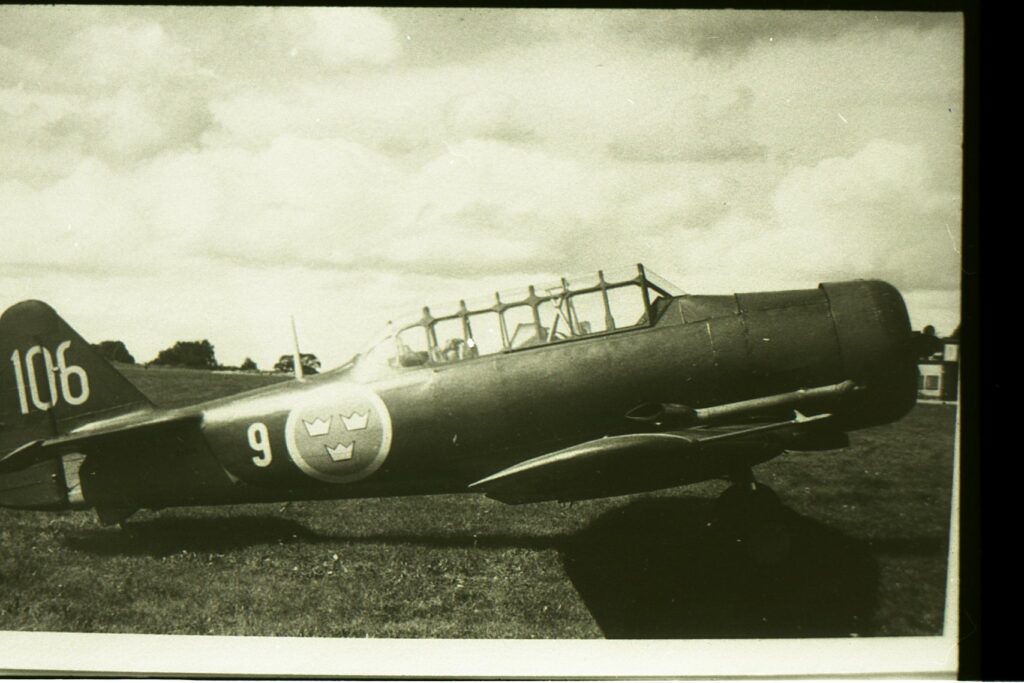
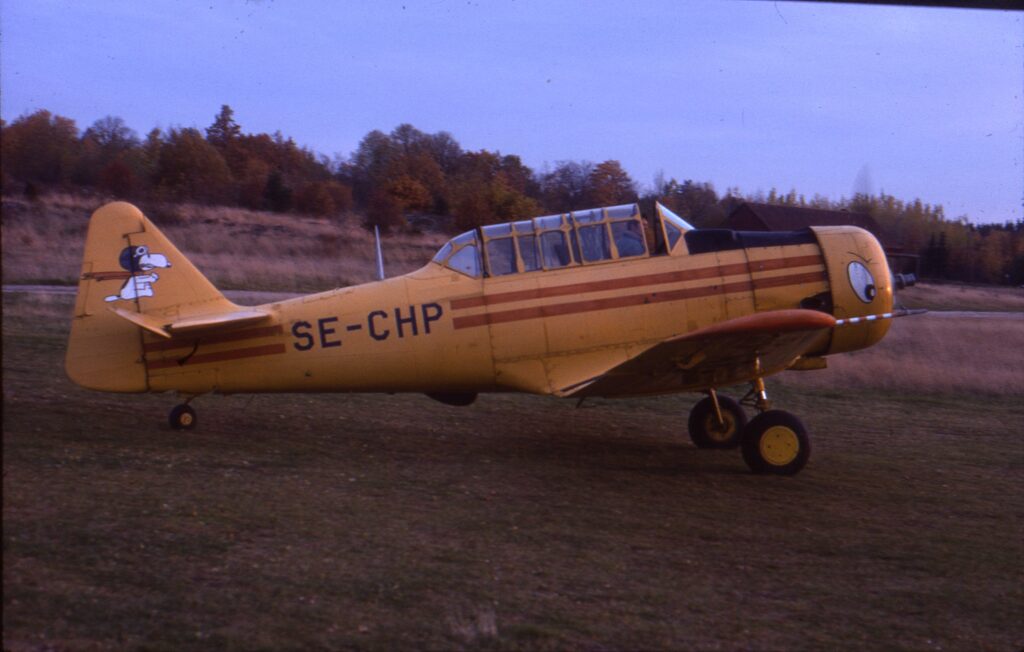
Eventually retired on March 30th 1972, the Harvard was bought by engineering company boss Jan Murer in Norway and registered LN-MAA on 12th September 1972. Painted a very dark olive colour with a Norwegian flash on the tail fin and codes ‘216’, the Harvard traveled through Groningen in Holland on March 16th 1975 en route to a new owner, David Jones of Glamorgan. The deal was possibly brokered by aircraft collector Doug Arnold as the Harvard was delivered via his Booker airfield and the new registration G-BDAM sounds like it could have been a personal identity. Richard Reeves of Knutsford was the next registered owner on 4th July 1979 (source: CAA site G-INFO). The Chairman of Pace Petroleum ( and later Aston Martin), Victor Gauntlett, acquired the Harvard on 22nd October 1981 and the trainer was finished in an RAF camouflage scheme with yellow undersides at Yeovilton. Victor Gauntlett owned a number of vintage aircraft over the years including Dragon Rapide G-AEML, Hornet Moth G-ADLY and C-47 N1944A but, with the Harvard, he decided to share the ownership with fellow pilots who wanted to fly display aerobatics. Victor worked with ex-RAF pilot Colin Dodds who did much of the flying of G-BDAM on the airshow circuit (1). On April 15th 1985, the Harvard was re-registered to Gauntlett, ex-Royal Navy helicopter pilot Norman Lees and ex-RAF pilot Dr. Euan English. In the mid eighties they put together the Harvard Formation Display Team flying from White Waltham and North Weald. G-BDAM was generally flown by Norman Lees, G-AZKI by Tony Hutton, G-AZSC by Gary Numan (of Tubeway Army fame), G-BGOU by Peter Snell and G-TEAC by Euan English. Gary Numan also flew G-AZSC as half of the ‘Radial Pair’ partnership with Norman Lees in G-BDAM. Together, they flew at many displays across Britain, Gary often landing at Earls Colne in ‘ZSC.
(1) Colin Dodds wrote an edition of Air Britain’s ‘ The story of De Havilland Dragon types’.
Unfortunately, the world of display-flying historic aircraft can be very dangerous and the roll-call of the five Harvard pilots began to diminish. Peter Snell died in his Harvard while performing a roll at Bourn in Lincolnshire in 1985. The ownership of G-BDAM passed to Euan English and Norman Lees on April 30th 1986 and display flying continued. Euan English was a director of North Weald Flying Services and, in March 1995, he took his Harvard up to practice manoeuvres prior to the North Weald Air Display. Flying with his son, Nick, in Harvard G-TEAC, Dr English was seen to commence aerobatics near Woodham Walter, north-west of Maldon, in the company of fellow Harvard G-BKCK. Both aircraft seem to have experienced fuel issues while performing Half Cuban manoeuvres and G-TEAC was seen to reach a vertical attitude before falling back into an inverted spin. Amazingly, the pilot recovered from the spin just before ground level and the Harvard achieved horizontal flight before having to pull-up to avoid trees. The Harvard hit the ground on the other side of the trees, killing Euan English and severely injuring son Nick (who had 30 bones broken).
CAA site G-INFO records that the ownership of G-BDAM passed to Dr English’s widow Karen on 16th April 1997. Norman Lees, previously the third team member to own G-BDAM, was, himself, killed in April 2000 while flying in a dual-seat Spitfire. His widow, ex-British Airways cabin member Catherine Lees, joined with Karen English to own G-BDAM between 21st May and 10th October 2001. Gary Numan saw the writing on the wall and sold his half of the ‘Radial Pair’ in October 2005 having seen too many deaths around the Harvard team.
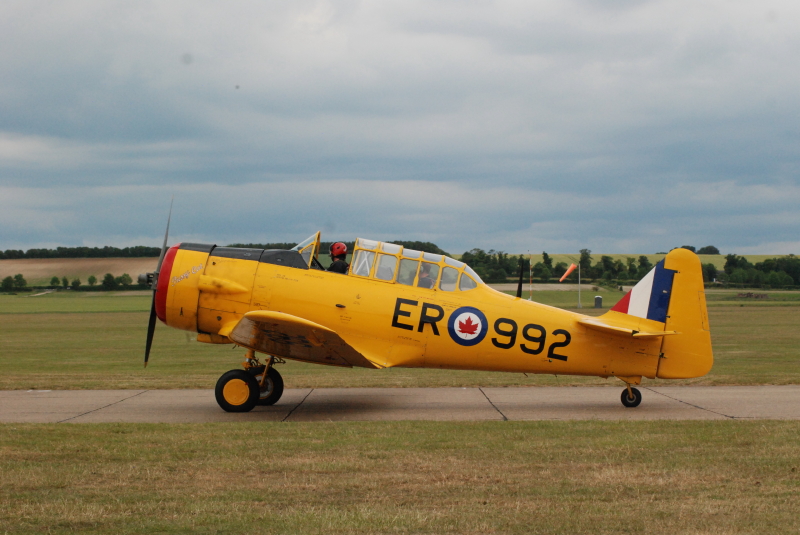
G-BDAM was bought by ‘Silver Victory BVBA’ , nominally of Brasschaat in Belgium, but was operated from Duxford by the Aircraft Restoration Company. It was then sold to Canadian architect and collector Ed Russell who planned to fly it from his South Niagara, Ontario, base. Russell had gained a big legal payout from Disney early in the 21st century and used some of it to buy a Spitfire, Hurricane and Bf109E as well as the Harvard. The paint scheme was changed to the yellow ER 992 format seen in our photograph and the registration C-GFLR taken-up. The small airport’s Sodom Road address possibly dissuaded visitors and the collection failed to achieve its targets. The Harvard ended-up spending several years in storage before being acquired by Black Star Aviation in 2016 in partnership with Classic Wings back at Duxford, England. She is currently (Summer 2025) named ‘Pussy Cat’ and offers air experience flights and air display appearances from the Cambridgeshire airfield.
Sources: Key Aero article by Chris Clifford, August 2018, CAA website G-INFO, Classic Wings website.
Part 2: A brief summary of the history of the AT-6 Texan, Harvard.
The North American Aircraft Company started life in 1928 as a holding company for various aviation interests including Eastern Airlines. A controlling interest was bought by General Motors in 1933 and the organisation pivoted towards manufacturing when holdings structures were banned from the US aviation industry in 1934. James Kindelburger, an ex-US Army Air service pilot instructor during WW1, joined NAA in 1934 and moved the Company’s base from the East Coast to Los Angeles. ‘Dutch’ Kindelberger had previously worked for 9 years at Douglas’s Santa Monica plant with engineer Lee Atwood. Both had worked on the DC-1 and DC-2 and it must have been a blow when they both moved to NAA to become President and Chief Engineer. In December 1934, the two engineers, along with H.R.Raynor, outlined the design of North American’s first trainer, the NA-16. It would eventually evolve into the Harvard/ Texan and become the most widely produced trainer ever. The type nomenclature is extremely confusing and isn’t clarified by different countries and branches of the military assigning it differing designations.
The NA-16 was designed by the three NAA engineers in nine weeks in response to a USAAC competition for a ‘BC-1 Basic Combat’ trainer. It first flew in Spring 1935 and was chosen by the Air Corps following several suggested modifications. NAA called the revised model the NA-18 and, again, built only one. The trainer would be put into production as the NA-19, classified by the USAAC as the BT-9. These aircraft were part metal, part tube and fabric construction, had fixed undercarriages and were BT Basic Trainers. Some variants were designated BT-14s and some large orders were received from overseas governments. A considerable order from France had not been fulfilled by the time of the 1940 invasion by Germany and almost 1200 BT-14 trainers were diverted to the RAF where they were named the Yale.
In the meantime, the USAAC had taken 42 Wright-engined BT-9s (NA-19) followed by armed BT-9As (NA-19As), unarmed BT-9Bs (NA-23) and BT-9Cs. The latter had ascended the NAA configuration scale as far as NA-29. Inbetween the BT-9B and C, NAA had built the NA-26 with a retractable undercarriage and Pratt & Whitney R-1340 engine. The NA-26 went on to win a 1937 USAAC to become the Basic Combat trainer and it went into production as the BC-1 (NA designations ranged from NA-36 to NA-55). A small number of BC-2 aircraft followed before it was decided that the type would become an Advanced Trainer henceforth to be known as the AT-6. It was different from the BT versions in that it had a triangular fin and new outer wings with squared-off tips and a forward-swept trailing edge. With production being fired-up in Dallas, the AT-6 became known as the Texan.
The RAf had shown immediate interest in the original NA-16, as had Canadian and Australian manufacturers. It is generally reported that the NA-16-1 was christened the Harvard 1 by the RAF with an initial order of 200 leading to a first flight on 28th September 1938. Engined by the 600 HP P&W R1340, the aircraft had a top speed of 180 mph which offered the RAF a trainer which sat between the De Havilland Tiger Moth biplane and front-line Hurricanes and Spitfires. The first examples were received in December 1938 by #3 Flying Training School although many early deliveries were sent to flight training schemes in Southern Rhodesia. The NA-16-2K was produced in Australia by the Commonwealth Aircraft Company variously as the Wirraway 1 (or CA-1), Wirraway II (or CA-3, CA-5, CA-7 and CA-8) and Wirraway III (CA-16).
Returning to Harvards: fifty Harvard Mk 1s had been bought by Canada and the first examples were delivered to British Columbia in July 1939. By early 1940, further Harvard Mk IIs were being manufactured at Inglewood, California, for the RCAF. The 1200 built for the RCAF had the all-metal fuselage rather than the tube/ fabric of earlier models and can be considered to be equivalent to the AT-6 rather than any version of the NA-16.
The Noorduyn Aircraft Company of Quebec had also taken an early interest with the 1938 negotiation of a licence to build the Harvard Mk II. Noorduyn had taken-over the old Curtiss-Reid factory in Montreal and would go on to produce at least 2800 aircraft. Their Harvard Mk IIA is generally considered to be equivalent to the AT-6C produced by North American. Canadian-built aircraft were used at fifteen military flying schools across the country as from 1941 but, from the end of WW2, many were decommissioned too hurriedly. With the onset of the Cold War, the RCAF needed to train more pilots and 100 T-6Js were leased from the USAF while a further 270 (possibly 285) Harvard IVs were built by the Canadian Car and Foundry Company (who had taken over Noorduyn) at Thunder Bay. Te Mk IVs were based on US T-6Gs which were upgraded, remanufactured Texans with square-tip props and a P-51 style undercarriage and steerable tail wheel. In Canada they were, confusingly, names T-6Js.
Often known as the ‘Pilot Maker’, the AT-6 Texan is variously reported as serving with as many as 55 air forces, including vanquished enemy Japan and the USSR, and has probably been used in the training of several hundred thousand pilots. Given the various designations outlined above, it is hard to give a definitive production number but it could be as many as 20,110 (some authorities quote 17,096 with 15,495 built as T-6s and 14,130 constructed between January 1940 and and August 1945). While North American’s Dallas factory is not amongst the best-known facilities of WW2, it was probably the most efficient and production. Not only did the factory produce AT-6s and P-51s, it also cranked-out B-25s and B-24 Liberators. By the end of WW2, some 19,000 aircraft had been built in the Dallas plant. It is also quoted that 6101 Harvards were built – G-BDAM, our photo example, is a Canadian constructed beauty.
Hits: 155