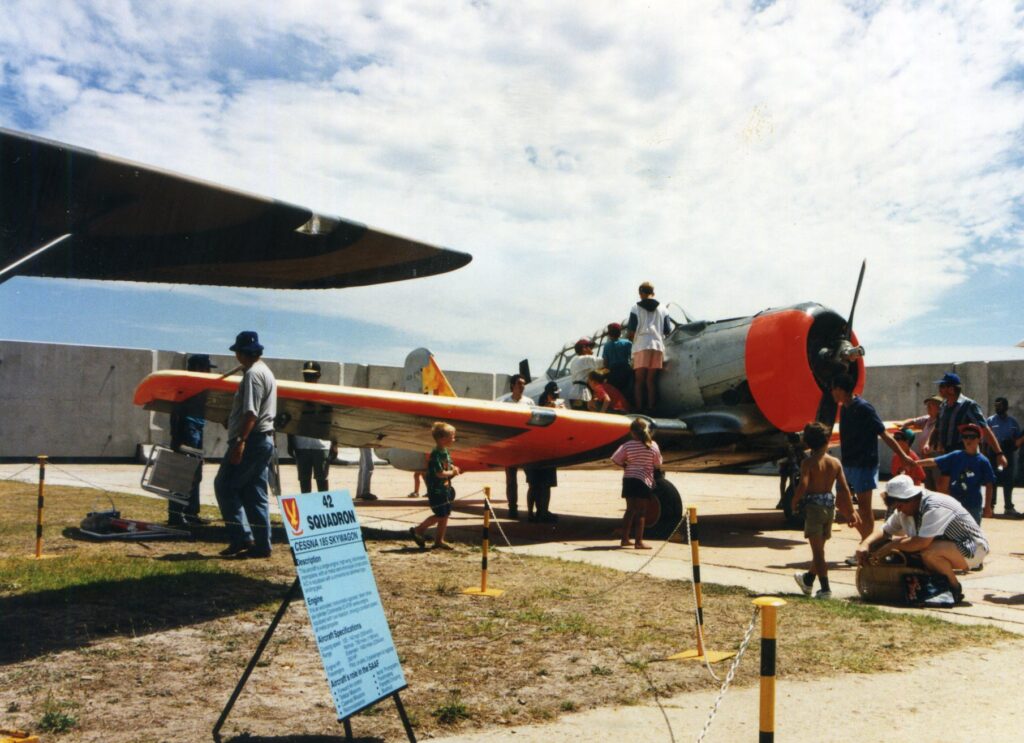
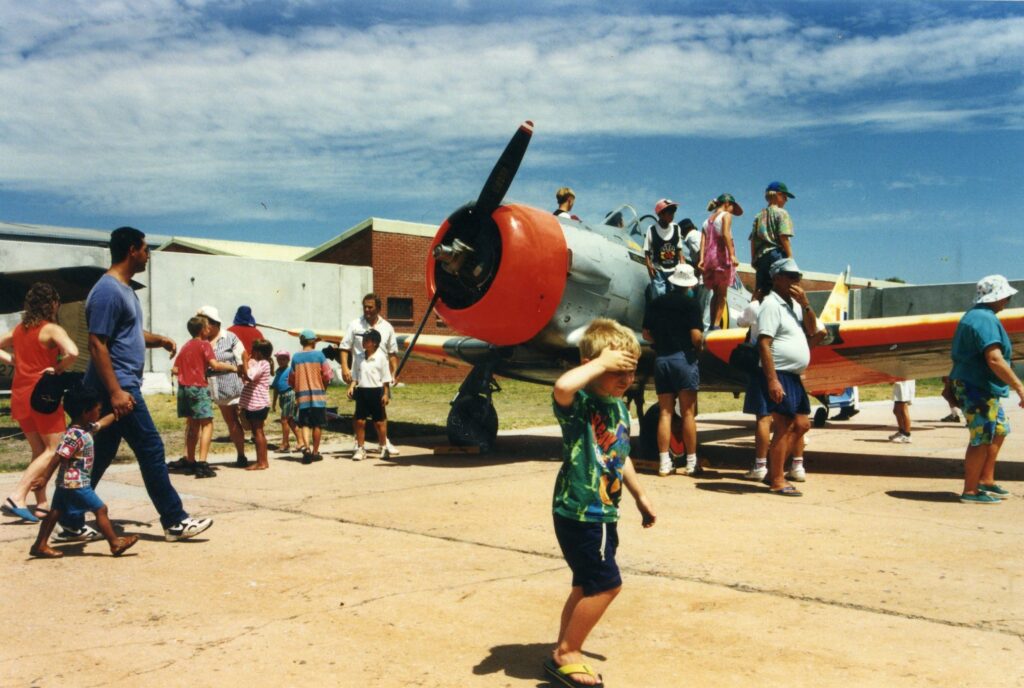
The SAAF was one of the last air forces to fly the Harvard.This example was at Ysterplaat Air Base near Cape Town at the 1995 commemoration of the 75th anniversary of the SAAF.
In the preceding snapshot, a Canadian-built Harvard IIb, FE992, was featured at the D-Day 75th Commemoration at Duxford in 2019. This photo shows a Harvard at another 75th anniversary – that of the South African Air Force at Ysterplaat Air Base, Cape Town in 1995.
The complications of the Harvard/ Texan family tree and the appropriate designations are covered in the Snapshot #5 summary. The Texan T-6 was used in over 35 countries over the years (indeed, some sources maintain that over fifty air forces used them) to train several hundred thousand pilots and the SAAF was one of the last to employ them in serious numbers. The RCAF had started retiring them, somewhat prematurely, during the late 1940s, the RAF retired them in 1955, the Swedish Air Force by the early seventies and the Portuguese Air Force around 1975. South Africa, however, was different. The apartheid government of PW Botha was subject to an arms embargo and had to use innovative work-arounds to prolong the life of their older airframes. When the Airborne Early Warning Shackletons were retired, the SAAF’s fleet of C-47s offered the base for AMD’s stretched turboprop Dakota which took over the marine patrol duties. The Harvard could emulate a fighter’s manoeuvrability and continued to deliver basic training and advanced instrument instruction for prospective air force pilots. Parts for the rugged 600 HP Pratt & Whitney R-1340 engine were still relatively easy to obtain, the aircraft was easy to maintain and over-engineered to a degree which made it very strong. That’s not to say that it was necessarily east to fly: as a heavy tail-dragger it could be a handful to land as it was prone to veering off the flight line and could readily ground loop. Although agile and appealing to aerobatic pilots, the Texan could prove dangerous even in the hands of experienced pilots – the sheer number of fatal crashes in the UK during the 1980s and 90s confirmed this.
The first Harvards assigned to South Africa were reportedly received for the Joint Air Training Scheme during October 1942 (although there may have been earlier arrivals in 1940) and, by July 1944, 633 had been delivered. 555 Mk IIA and Mk III Harvards survived the trainee pilots to make it onto the October 1945 inventory. As they had been supplied under Lend/ Lease, 300 were returned to the USA via the UK at the end of hostilities (1). The South African Air Force purchased a further 65 post-war AT-6Ds and 30 T-6Gs between 1952 and 1956. The colour scheme changed little over the 50+ years: the aircraft sported a natural metal finish with dayglo wings, engine cowling, aft fuselage, fin and tailplane. Each carried its four digit identity in large black numbers on a yellow rectangle on the fuselage side. The RAF roundel evolved with the superimposition of the Springbok and was subsequently replaced by the 5-pointed SAAF Castle design, still with the Springbok.
The trainers were equipped with Browning .303 machine guns, fragmentation bombs and various rockets.
The SAAF eventually retired the Harvard in 1995, shortly after these photos were taken. Over 120 of the trainers had flown with the Air Force and, to mark retirement after 55 years, a formation of 55 Harvards carried-out a flypast of the Ysterplaat Air Base in Cape Town on 17th November 1955, the last day of service.
(1) Over 5000 T-6s were supplied to Commonwealth air forces under the Lend/ Lease scheme.
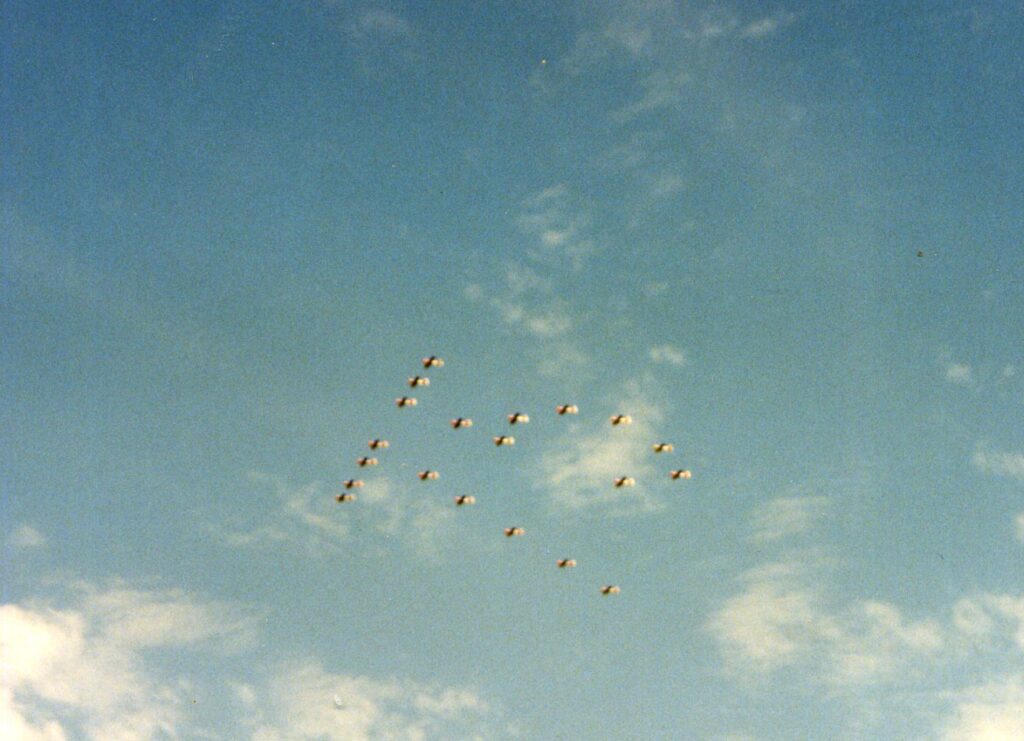
On the last day of regular service with the SAAF, 55 Harvards apparently flew in formation along the Cape Town coast to mark an amazing 55 years of service. Here, 20 Harvards maintain a creditable '75' formation to celebrate the SAAF's 75th anniversary in 1995.
The SAAF had held a very large spares inventory for the Harvard and this was auctioned-off along with most of the remaining airworthy trainers in 1998. The majority of the lots were bought by Dallas-based Lance Aircraft. The Texan (appropriately) company had grown to be the World’s largest stockist of Harvard/ AT-6/ Texan spares with a 70,000 square foot warehouse dedicated to the type. Initially formed in 1967 by Latvian-born Morey Darznieks, the Company had started by supporting T-6s being operated in Texas as crop dusters with a supply of Pratt & Whitney engine spares plus propellers. Early overseas purchases of large spares lots included the Swedish Air Force stocks in 1967. Ten years later the Indian Air Force’s fleet of 87 airframes and the supporting spares inventory was purchased by Morey.
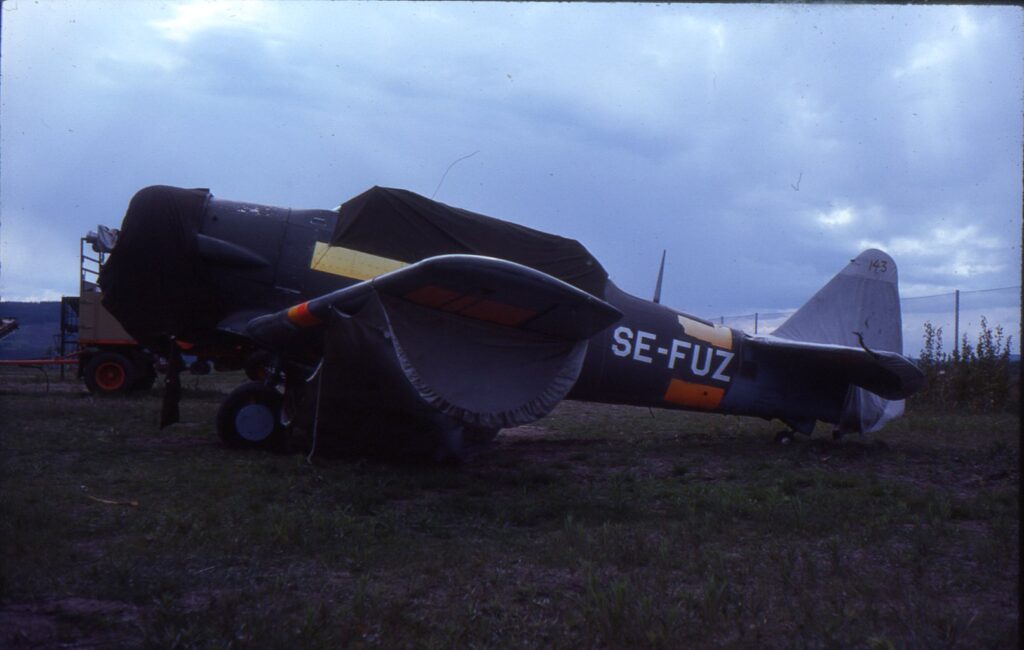
The Swedish Air Force sold many of its Harvards and a large spares inventory to Lance Aircraft in 1967. Other Harvards, such as SE-FUZ seen here nine years later, made it onto the Swedish civil register.
When the US aerial top-dressing industry was largely destroyed by government changes to subsidies during 1983, Morey switched to specialising in all T-6 parts. Lance Aircraft bought the company which North American had licensed to make new T-6 parts, Smith & Smith, and, in 1986, also acquired their chief competitor, Chesapeake Airways. This gave Lance Aircraft Supplies almost 90% of the remaining parts supply for the AT-6, Harvard and SNJ. The purchase of the SAAF stock was the last big target available to Lance and they expended a lot of effort and dollars in purchasing the South African stock. Today Morey Darzniek’s company is run by his son, John, and is able to offer an immense stock of mostly unflown (90%) Harvard spares via next-day shipping within the USA from the Company’s base.
The 75th anniversary of the SAAF was celebrated in 1995 with a number of displays around the country. The Harvard was about to be retired after 55 years service in favour of Pilatus PC-7 trainers but featured in many of the displays including this one at Ysterplaat, Cape Town. The ground display example is in the standard SAAF markings: natural metal with dayglo orange engine cowling, tailplane, aft fuselage and wings; the serial is inscribed in large black digits on a yellow rectangle on each side.
The departure of the large spares shipments to the USA made domestic flying of the Harvard in South Africa more expensive but, fortunately, the trainer has many supporters in the country and the ‘Harvard Club of South Africa’ was formed. Created at the Central Flying School at Dunnotar in 1990 by past and present members of the SAAF, the Club initially celebrated the fiftieth anniversary of Harvard operations in South Africa. Shortly afterwards, it was announced that retirement of the Harvard would commence the following year with the introduction of Pilatus trainers. The Club requested that four Harvards should be retained to celebrate their air force heritage. Eventually, ten aircraft were identified for preservation along with a suitable spares support package. The first three were handed over to the Club in 1994 and were based at Springs until 2000 when it was decided that the SAAF Museum and national heritage centre would be established at Swartkop. The ten Harvards moved to their new home and were designated National Heritage items which should ensure that they remain in South Africa. Six of the ten are maintained in flying condition and appear regularly in the skies of South Africa.
Amazingly, there are over thirty Harvards flying in South Africa including the five operated by the Eqstra Flying Lions display team (2). Their display involves four aircraft flying ambitious manoeuvres including, where there is an adjacent lake, the unusual ‘water skiing’ feature where a Harvard skims the water surface with the lowered undercarriage wheels. Most of the Team’s display pilots are ex-South African Airways fliers. Although the Harvard is no longer cheap to buy or fly (3), it is possible to support costs by display flying to an extent which would be impossible for a rarer craft such as a Spitfire or a Mustang.
(2) Recently, the team has been renamed after new sponsors, Puma.
(3) Post-war, the Harvard could be acquired for as little as $450, sometimes with fuel in the tanks ! With the Harvard’s hourly consumption of around 30 US gallons, that Avgas would be very welcome at today’s prices.