SNAPSHOT 8 – SAAF SHACKLETON 1719

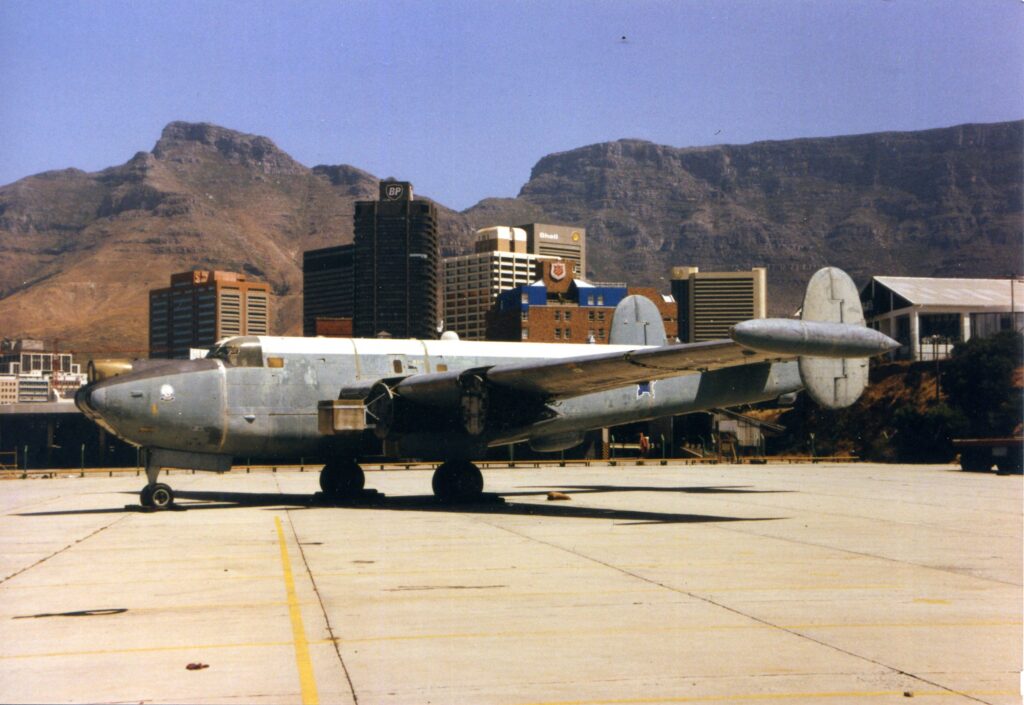
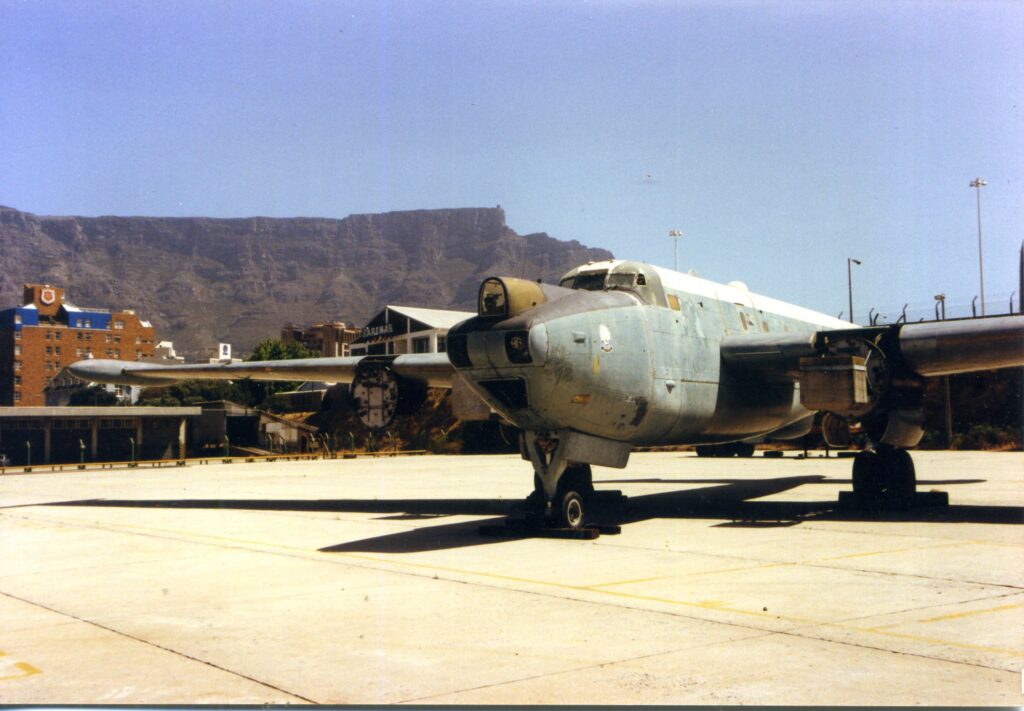
SAAF Shackleton 1719 L c/n 1529 Cape Town Waterfront
Shackleton 1719 /L, construction number 1529, seemed destined for preservation. Following an early post-retirement stint at the Stellenbosch Aero Club, the veteran was moved to Cape Town's Waterfront at the start of the development. However, it deteriorated in the marine atmosphere, wasn't looked-after and was cut-up.

Another classic which survived in an operational role with the SAAF into the eighties, the Shackleton was partly replaced by upgraded C-47s. This Shackleton, 1719, was one of eight MR3 versions built for the South African military.

The Shackleton was the last of a line of famous four-engined aircraft built by A.V.Roe of Manchester. Its most revered ancestor was undoubtedly the Lancaster bomber whose operational excellence led to a production run of 7377 aircraft. The Lancaster had, itself, been developed from the under-powered two engine Manchester of 1940. A four-engine prototype Manchester swapped the two unreliable Vulture engines for four Merlins. Production, as the Avro Lancaster, began in autumn 1941. Some were later civilianised as Avro Lancastrians and a proper civil airliner, the Avro York, was designed by Roy Chadwick’s team using the wings, tail plane and engines of the Lancaster paired with a boxy airliner fuselage. Ninety-one Lancastrians were produced in the UK and Canada and 257 Yorks had been delivered by the time production ceased in 1948. The last Lancasters were delivered in 1946 but, by then, the next generation of the family, the Avro Lincoln, had been in RAF service since February 1945. The end of WW2, fortunately, removed the requirement for these two bombers in a Far East ‘Tiger Force’ and the Lincoln production run in the UK halted in 1951. While modified versions of bombers such as the Halifax, B-17, Wellington and B-24 Liberator had shared wartime maritime duties with flying boats such as the Catalina and Short Sunderland, not many Lancasters joined Coastal Command. Post-war, some examples were sold to allied air arms such as the French Aeronavale but Coastal Command were hoping for a marinised version of the Lincoln which could offer a greater range and heavier weapons load. Discussions held between Avro and the Air Ministry during 1946 initially concentrated upon producing a Lincoln III tailored for maritime reconnaissance. The design which emerged from Specification R5/46 was based on a Lincoln wing and undercarriage combined with a fuselage which was originally to be shorter and fatter than the Lincoln. Engines would be Rolls Royce Griffons rather than Merlins and each would drive two three-blade contra-rotating propellers. Oddly, inboard engines were to be Griffon 57As, outboard Griffon 57s…and the two were no interchangeable! At Roy Chadwick’s suggestion, the new design would be called the Shackleton and this quickly evolved into the 1A with four Griffon 57A engines. Entering service with RAF Coastal Command in 1951, the Mk1 gave way to the Mk2 in 1952/ 53 and the Mk 3 in 1955. The MR3 was substantially different and was designated the Avro 716 rather than the Avro 696 of the Mk1 and Mk2. It had a different wing, better ailerons, a tricycle undercarriage with nosewheel steering and wing tip tanks. The dorsal turret was removed, crew accommodation improved and better underwing weapons deployment points installed.

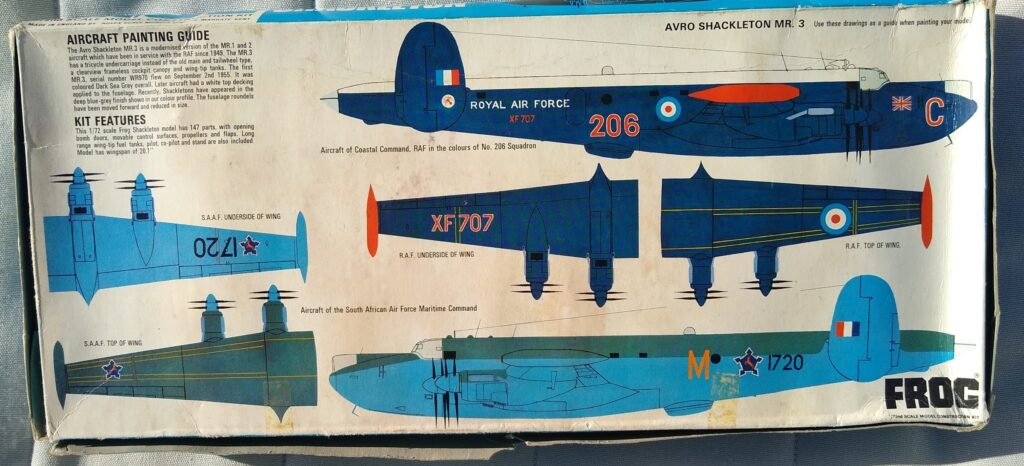
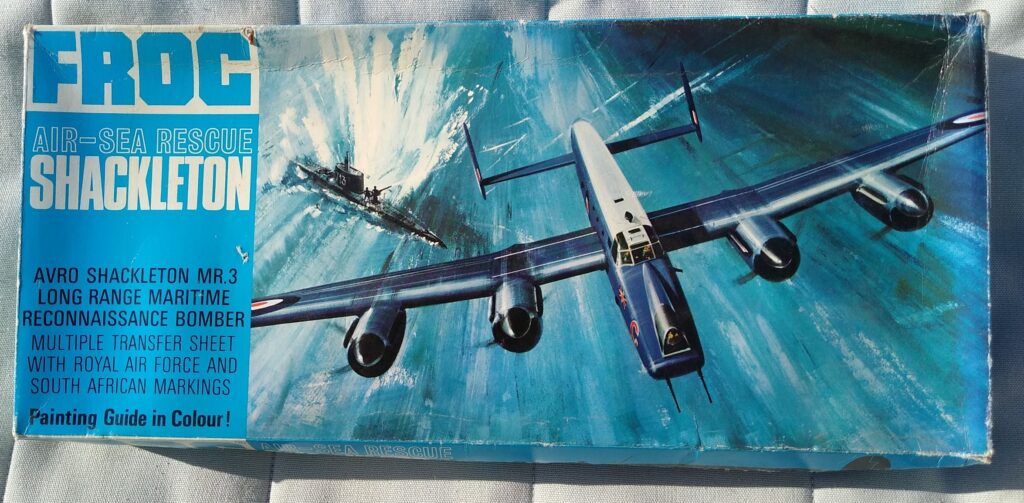
Frog 1/72 Shackleton kit SAAF and RAF colour scheme
The Frog 1/72 scale model of the Shackleton MR3 introduced many modelers to the South African version of the maritime reconnaissance classic.

Although the SAAF had appraised the MR2, it was the MR3 which they considered would be most suitable replacement for their rapidly aging Sunderlands. Very long range patrols meant that the wing tip tanks were essential – as was the improved sound proofing! An order for eight aircraft was placed with Avro at Woodford. The SAAF examples would be capable of 200 mph and have a range of 4215 miles. They were to have 2 x 20mm nose cannons and a 10,000 lb weapons load. The MR3 first flew on September 2nd 1955 and the first three were ready for delivery to South Africa in Spring 1957. Forty-one members of the SAAF’s  35 Squadron arrived at Woodford in February 1957 ready for training and familiarisation. Shackleton c/n 1526, which would become 1716, was the first to fly, on March 29th 1957, and was officially accepted on 16th May along with 1717 (c/n 1527, first flown May 6th 1957) and 1718 (c/n 1528, first flown 13th May 1957). 1716 and 1717 were taken to RAF St.Mawgan in Cornwall on May 21st to participate in a combined exercise with RAF Coastal Command. The latter proved to be rather envious of the new aircraft as they were still using Mk 2 Shackletons.

SAAF RAF Frog 1/72 Shackleton
The Frog 1/72 Shackleton model included decal and colour schemes for RAF and SAAF aircraft. The latter initially painted the first three aircraft in Phot reconnaissance blue with dark grey upper surfaces.

The first batch of three aircraft departed for Waterkloof Air Force base, South Africa, on 13th August. They arrived between 17th and 19th August and all three flew on the 35 Squadron’s Cape Town base on March 19th. The next two SAAF aircraft, 1719 c/n 1529 and 1720 c/n 1530, were first flown on 6th and 26th September 1957 respectively. They were painted in the same scheme as the first three: photo-reconnaissance blue with dark grey upper surfaces. 35 Squadron accepted them ex-factory in January 1958 and they both departed for Cape Town on February 8th, arriving five days later.

The last three aircraft (1721, c/n 1531, 1722, c/n 1532, and 1723 c/n 1533) were first flown on 12th December 1957 and 7th and 10th February 1958 respectively. They were different from the first five in that they had white upper surfaces. All three departed the UK on February 14th 1957 and arrived in the Cape on 26th February. 1723 had hydraulic issues and lost all braking during the landing at Ysterplaat. It hit a building and #1 engine was damaged. Fortunately, pneumatics had been available for undercarriage and flap control but, during their long career, five of the eight Shackletons would experience mishaps while landing.

The Shackletons went on to have a distinguished career with the SAAF, patrolling the east, west and south coasts of the RSA for 27 years. Indeed, their domain extended way to the south towards Antarctica as they were sometimes called upon to support the SA Meteorological station on Marion Island, some 1190 miles south of Cape Town. Another low-key island also provided the longest mission flown by the SAAF Shackleton fleet: Europa Island in the Mozambique Channel was the subject of a 21 hour 10 minute return flight from 35 Squadron’s Cape base.

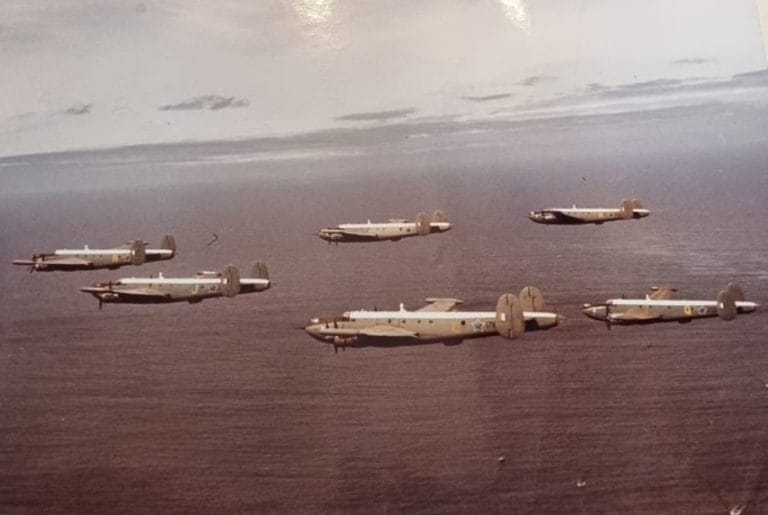
Six strong Shackleton patrol SAAF 35 Squadron
A six strong patrol of SAAF Shackletons flown by 35 Squadron crews. Photographer currently unknown.

Other notable missions operated by 35 Squadron included the rescue of the crew of an SAAF Buccaneer which ditched during its delivery flight and the depth-charging of the SS Wafra in February 1971. The Wafra was a tanker which had suffered a loss of propulsion while rounding Cape Point. Taken under-tow by a Russian tanker, it was soon evident that the rescuer had insufficient power. The tow was transferred to a second vessel but the tow wire parted and Wafra ended-up on the rocks at Cape Agulhas, the southern tip of Africa. Refloated, the tanker was towed 200 miles out to sea to a point where SAAF Buccaneers were called-upon to sink the hulk. They failed and 35 Squadron’s Shackletons were called-in to complete the job using depth charges (1).

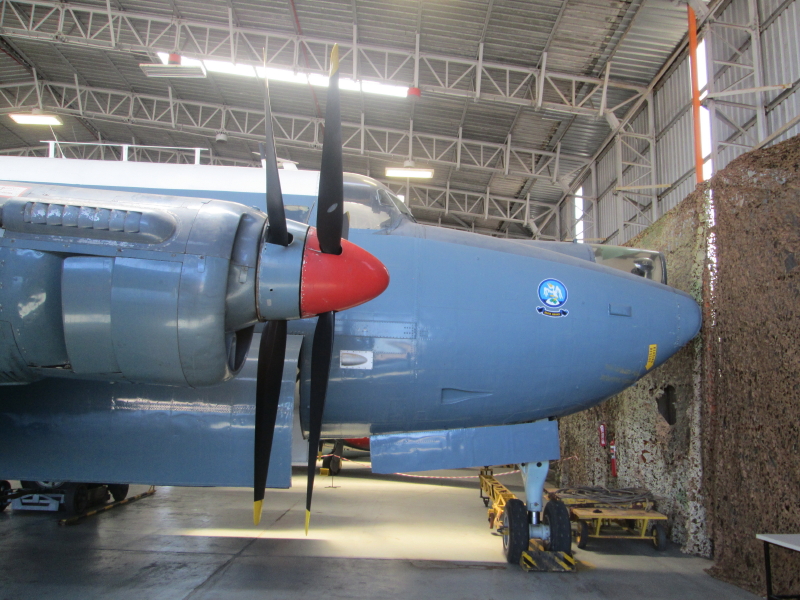
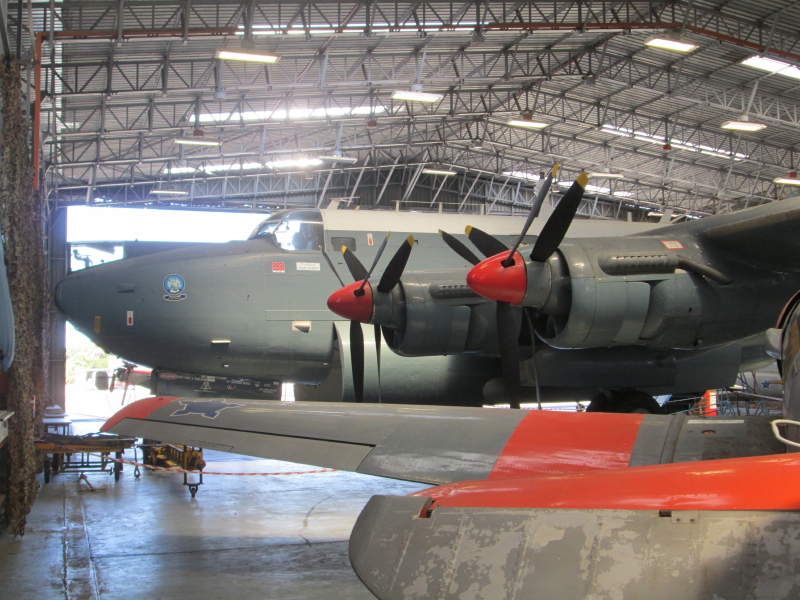
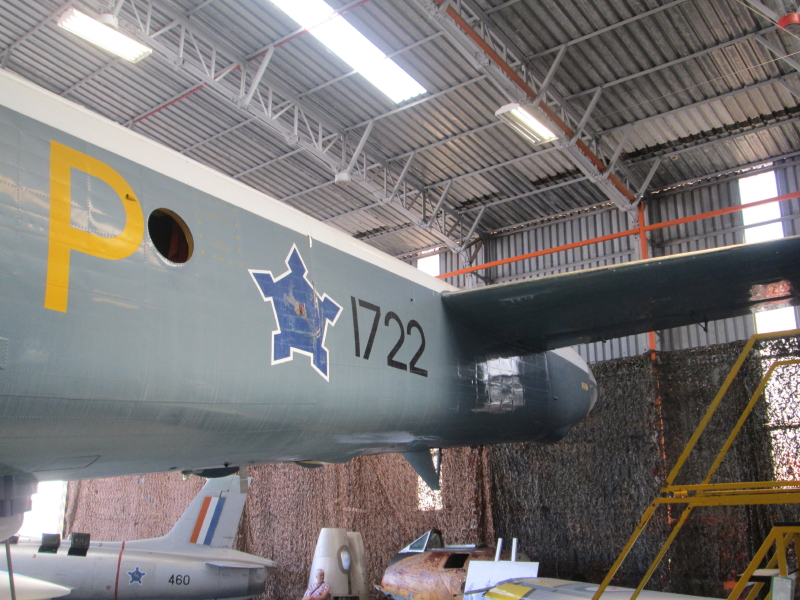
The long operational history of the Shackleton fleet meant that metal fatigue issues related to long flying hours surfaced by the 1970s. The fatigue index component is considered to be the lower wing spar boom and 6300 flying hours was chosen as the limit. 1716 was re-sparred in a long and expensive programme run by the SAAF engineers between March 1973 and April 1976. 1720 was retired in 1983 at the end of its fatigue life. The Shackletons were eventually retired in 1984 and three aircraft, 1716, 1721 and 1722, took part in a retirement flypast over Cape Town on 23rd November 1984. While 1716 and 1721 were subsequently flown to the SAAF Museum in Waterkloof, 1722 was closeted in a hangar at DF Malan Airport, Cape Town. 1722 continued to be maintained in excellent condition by Warrant Officer Henry James Potgieter and his team and flew to Ysterplaat in November 1991. It remained in flying condition until 24th September 2006 and continues to perform ground runs at Ysterplaat.

(1) This ecological disaster made the South African government realise that the country had no ocean-going tugs capable of intervening in a similar disaster. This led to the construction of the famous Safmarine tug duo, the John Ross and the Wolraad Woltemade.

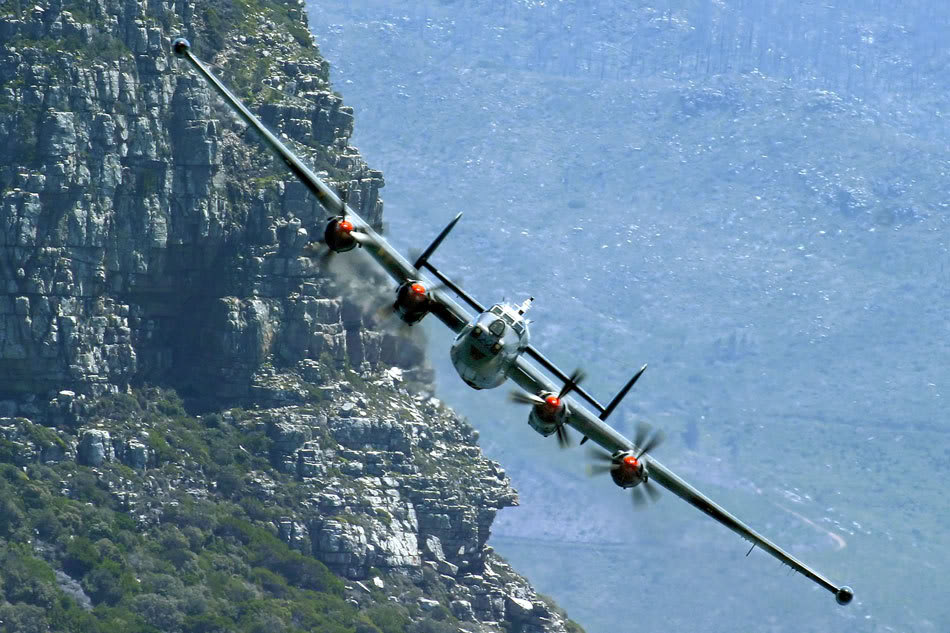
SAAF Shackleton 35 Squadron Cape province
Fantastic shot of an SAAF Shackleton around the Cape Coast. Photographer currently unknown.

The subsequent history of the ‘SAAF Eight’ is given below. Information is derived from Brent Best’s post on the SAAF Forum pages.

1716, J: c/n 1526. Arrived in the Cape 19/8/57. A new spar was fitted between March 1973 and April 1976 promoting its longlevity. It was one of the three aircraft which took part in the November 1984 retirement flypast. It was restored to airworthiness in 1994 using parts from 1721 and departed for the UK on July 8th 1994 where it was due to participate in the Royal International Air Tattoo at RAF Fairford. Routing north through Libreville, Gabon, and Abidjan, Cote d’Ivoire, it encountered problems on the next leg to Lisbon and crashed near the Mauritanian border. The 19 crew and supernumaries on board all survived but the Shackleton remains marooned in the Sahara.

1717, O: c/n 1527. Arrived in the Cape 19/8/57. A new spar was fitted between September 1975 and October 1977. It was later withdrawn from use at Ysterplaat and, in 1987, it was shipped by sea to Durban before being trucked inland to the Midmar Dam. It was incorporated into the Natal Parks Board Transport Museum at their Midlands Historic Village. When this popular feature closed around ten years later, 1717 was sold for R55,000 to a Mr Desai of Kwadukuza/ Stanger. Whatever the forward plan was at the time, it didn’t materialise and the aircraft was cut-up for scrap in 2006. The engines may have been sold to a UK purchaser.

1718, K: c/n 1528. Arrived in the Cape 19/8/57. Following a wheels-up landing at DF Malan airport on 9th November 1959, it was repaired and back in action by 1960. It was later involved in the fleet’s only fatal crash on 8th August 1963. 35 Squadron was taking part in a combined exercise with the Royal Navy and 1718 was scheduled to fly to Port Elizabeth in very poor weather conditions. The Captain chose to fly directly across the Cape mountains despite being briefed to fly around the coast. It would appear that the Shackleton suffered from extreme icing over the Wemmershoek Mountains and broke-up, crashing in a remote part of the Stettyn family wine estate to the north-east of Franschhoek. All thirteen crew were killed.

1719, L: c/n 1529. Arrived in the RSA on 13th February 1958. It returned to the UK for crew training with Coastal Command on 25th February 1963, returning to base on 1st April. It was withdrawn from use on 24th April 1978 and stored at Ysterplaat. It was initially scheduled for preservation and delivered to the Stellenbosch Aero Club for use as their clubhouse. As the Cape Town harbour Waterfront development began to take-off, 1719 was moved there for static display. It wasn’t maintained properly and began to disintegrate in the marine atmosphere. Eventually, it was cut-up – possibly after being transferred to Ysterplaat.

1720, M: c/n 1530. Arrived in the RSA on 13th February 1958. It was damaged at the end of a training flight on 18th September 1961 when it undershot while landing at DF Malan. Although badly damaged, a hangar was erected around the aircraft and repairs were successfully completed. It was eventually retired on 10th March 1983 owing to its fatigue history.  Initially displayed outside the Warrant Officer’s mess at Ysterplaat, it was sprayed in the delivery colours of 1717 (for some reason). 1720 was the subject of the Frog 1/72 scale model where it also featured the original PRU blue and dark grey colours. The Shackleton reportedly corroded to a point where it needed to be cut-up in 2013.

1721, N: c/n 1531. Arrived in Cape Town on 26th February 1958. It was damaged in a wheels-up landing at Ysterplaat on September 10th 1962. It was one of the aircraft used to sink the tanker SS Wafra in March 1971. Having taken part in the final Shackleton fly-by at DF Malan airport on 23/11/1984, she was flown to the SAAF Museum at Swartkop in December 1984 and placed on static display. Some parts were used to keep 1716 flying.

1722, P: c/n 1532. Arrived in Cape Town on 26th February 1958. It suffered a nosewheel failure on 7th June 1960 and landed on a foam carpet at Langebaanweg. After returning to service, the Shackleton traveled to the UK on 28th June 1964 to take part in a Joint Anti Sub School at RAF Ballykelly. It returned to Cape Town on 30th July 1964. Over 20 years later, 1722 took part in the final fly past on 23rd November 1984. Retained in ground-running condition at DF Malan, the team of WO Potgieter kept her in good condition for the SAAF Museum. Her last public flight was on 24th September 2006 at the Africa Aerospace and Defence Show. It was subsequently restricted to ground running although she made a further flight in the hands of Captain Peter Dagg on 29th March 2008, departing DF Malan, crossing over Robben Island and landing at Ysterplaat. She has remained there ever since, although engine runs still take place.

1723, Q: c/n 1533. Arrived at Ysterplaat on 26th February 1958. It was the last Shackleton to arrive and the first to be retired, on 22nd November 1977, at the end of its fatigue life. It was stored in the open for many years before being sold to Vic de Villiers in Johannesburg. De Villiers owned a Caltex service station which had enjoyed a Vickers Viking mounted on the roof when it was called Vic’s Viking Garage. In March 1987, it was agreed that the Viking would go to the South African Airways Museum and a replacement would be found in the form of 1723. When first mounted on the roof, 1723 was painted in SAAF colours but it was subsequently finished in a rather horrible red Coca Cola colour scheme. More recently, it has been resprayed in the (marginally) more acceptable Sasol blue and white colours.
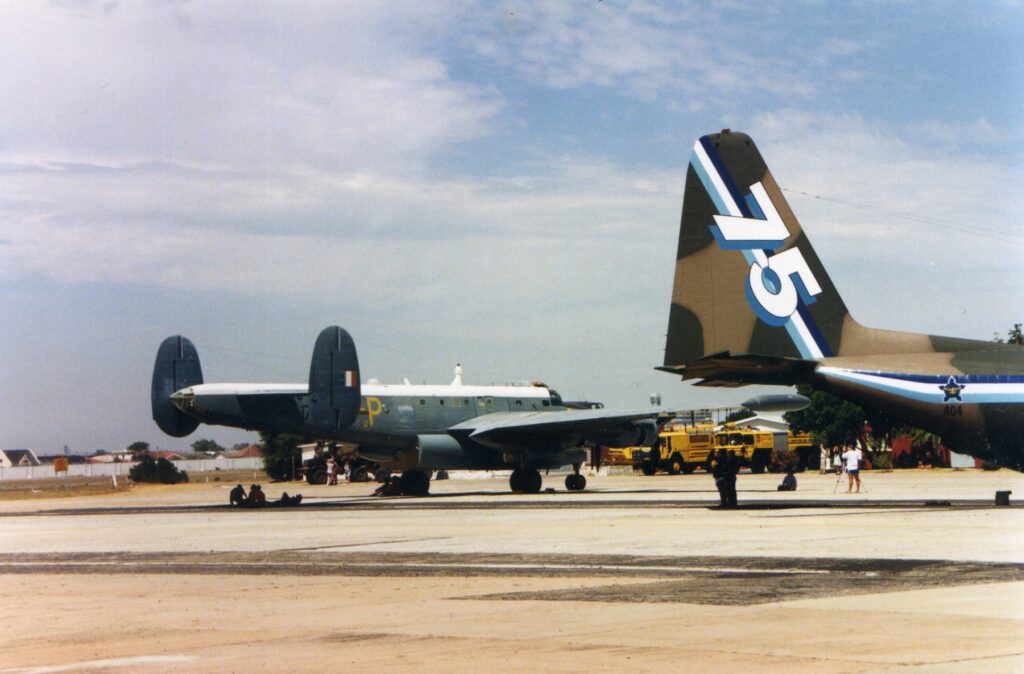
Shackleton 1722 at ysterplaat SAAF 75th anniversary display
Shackleton 1722/ P at the Ysterplaat Air Display to mark the 75th anniversary of the founding of the SAAF.
1716 crash on border of Mauritania and Western Sahara
Shackleton 1716 crashed in the Sahara Desert while flying between Abidjan and Lisbon en route to the UK in July 1994. Photo from Facebook post of Ian Hunter, photographer unknown.

Hits: 5