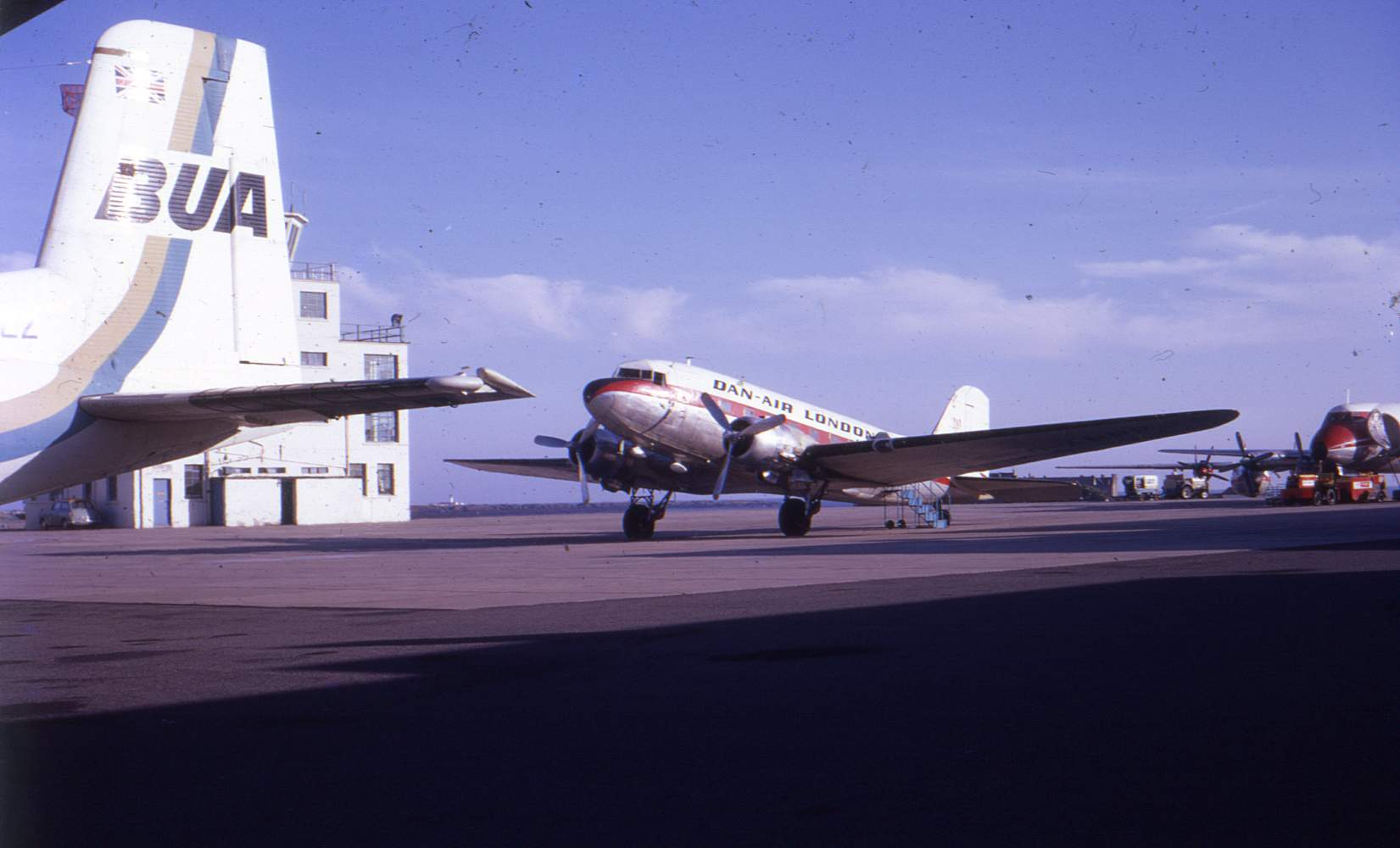

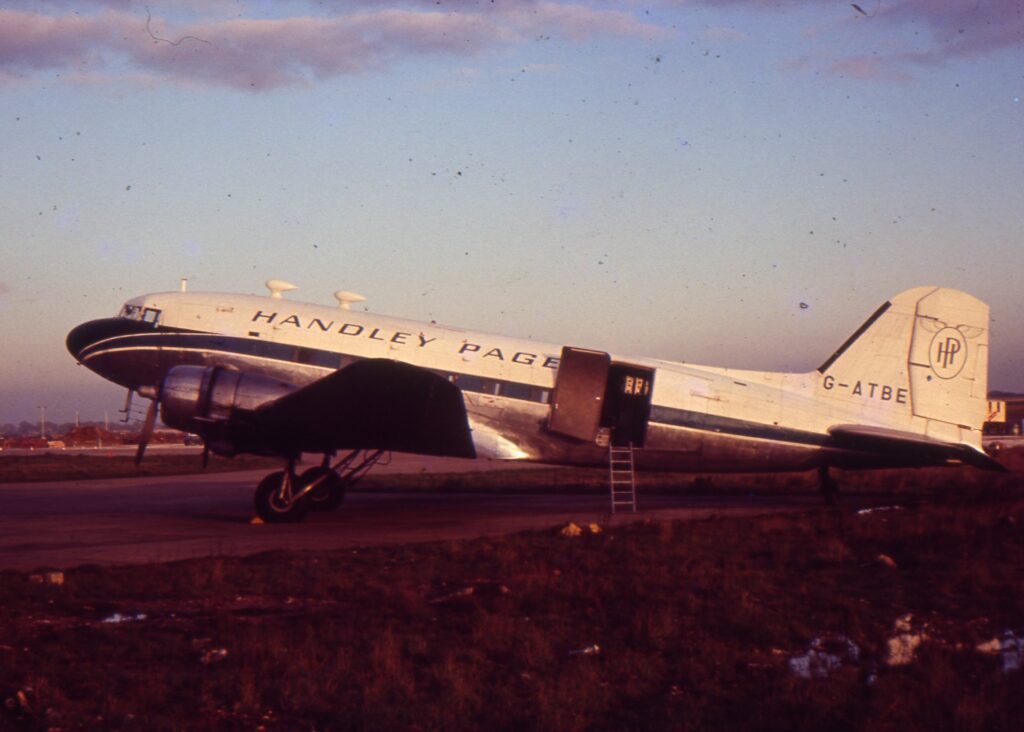
Snapshots 9 & 10 were taken on a sunny afternoon at Luton Airport and Snapshot 11 completes the trio of historic aircraft parked outside the Autair hangar.
G-ATBE has a very different history to many British-registered Dakotas as is evidenced by its late appearance (for a C-47) on the register. Two detailed articles have already appeared in Propliner magazine and much of the information here has been paraphrased from the authors hard work:
‘Around the World in 27 years’ written by Karl Hayes and Eamon Power appeared in Propliner #51.
‘Renewing an Old Acquaintance’ by Anthony J.Hickey appeared in Propliner #75, Summer 1998.
42-23951, c/n 9813, was delivered to the USAAF on 5th July 1943 and assigned to the 40th Troop Carrier Squadron, 5th Air Force, at Brisbane, Queensland, Australia. Arriving on August 20th 1943, the C-47 was named ‘Lynda Jeanne’ and had a relatively brief military career. The US Government presented a dozen C-47s to Australia and these were allocated by the Department of Civil Aviation to domestic airlines. Qantas took delivery of a trio of leased C-47s on 28th August 1944 and commenced operations the following month. C/n 9813 moved on to the civil register as VH-AFA on March 24th 1945 and, a few days later, operated Qantas’ first service between Sydney and Papua New Guinea on April 2nd. This long-distance route was initially operated once a week by all-silver DC-3s flying Sydney/ Brisbane/ Rockhampton/ Townsville/ Cairns/ Port Moresby/ Lae. By the end of 1945, the route frequency had increased to thrice weekly.
The Government create the Australian National Airlines Commission in 1946 and the eleven surviving C-47s which had been gifted by the US Government were transferred to the new organisation. With a remit to operate internal air services under the name Trans Australian Airways, the new company received VH_AFA on September 11th 1946 with a total of 6434 flying hours. Based at Melbourne, VH-AFA flew services all over the country between the big cities of the east coast plus cross-country routes to Alice Springs, Canberra and Perth. As more modern airliners were introduced, the DC-3 fleet was moved to shorter, more local routes and, on August 21st 1957, VH-AFA operated its last revenue-earning flight for TAA. Australian Aircraft Sales of Sydney took ownership of the aircraft on 31st October 1957 along with several other ex-TAA C-47s. VH-AFA had flown an impressive total of 32,084 hours.
The broker succeeded in selling four of the ex-TAA C-47s to the West African Airways Corporation and VH-AFA became VR-NCO on November 1st 1957. The ex-TAA aircraft were part of a seven-strong group of C-47s joining WAAC following the departure of the two B170 Freighters sold to Channel Airways in 1957/58. The Dakotas followed routes ranging from Jos and Makurdi in the east to Dakar in the west, a huge area servicing Nigeria, Ghana, Sierra Leone, Liberia, Cote d’Ivoire and Gambia. When WAAC’s constituent countries decided to develop independent national airlines, VR-NCO moved to WAAC (Nigeria) on October 1st 1961. Following independence, the company became Nigeria Airways and VR-NCO was registered 5N-AAO in 1961. However, the new airline had plans to upgrade to turboprop equipment and five Fokker F-27s were ordered in September 1961. Once the F-27s began to arrive in early 1963, the C-47s were offered for sale and 5N-AAO was an early departure, heading north to join Aer Turas in the Emerald Isle.
Aer Turas had been formed in 1962 and operated a low-key charter operation with a single Dragon Rapide based at Dublin Airport. Early expansion plans focused on the Rapide’s metal successor, the DH Dove, but second-hand Dakotas were available for similar money and Nigerian Airways’ redundant C-47 seemed to be a good prospect. Following an air test at Lagos on 21st February 1964, the sale was agreed swiftly enabling the ferry flight to commence the following day. Captain J.O’Donoghue piloted 5N-AAO to Abidjan, then Freetown in Sierra Leone, Dakar, Las Palmas, Gibraltar, Bordeaux, Dinard and Jersey, eventually arriving in Biggin Hill in early March. Registered EI-ANK on March 9th, the Dakota departed for Dublin on 26th.
Spring and summer 1964 proved to be an early highlight for Aer Turas with the Dakota flying Aer Lingus freight schedules from Dublin to Birmingham, Bristol, Liverpool, London and Manchester as from April 5th. Ad hoc freight charters visited Cambridge and Newcastle and there were night time deliveries of Irish lamb to Paris. Passenger charters conveyed Irish students to the Channel Islands for fruit-picking, enthusiasts to Heathrow for the Farnborough Air Show and greyhounds to Spain. However, as winter drew-on, operational problems threatened: passenger charters declined, the Aer Lingus freight work dried-up and the Dakota’s past life in warm climates meant that it wasn’t adequately equipped for a European winter. More precisely, the airliner had not been factory-equipped with de-icer boots and, with the Pacific as its initial theatre of operations, it had been fitted with fixed cowling gills. The Irish Department of Transport required the winterisation work to be completed but Aer Turas’ finances were limited. EI-ANK flew a final service for the airline on October 23rd 1964, a return flight between Dublin and Bristol, before being parked-up for a month. On November 22nd, EI-ANK was flown to Gatwick before moving to Shoreham two days later. The Irish registration was cancelled on January 15th 1965 and the Dakota was re-registered to K.W.England as G-ATBE on February 23rd. The new owner was connected with the projected start-up of a Guernsey-based airline which planned to use two C-47s and a Bristol Superfreighter to fly cargo charters between the Channel Islands and Northern France, England and the Irish Republic. In the spring, G-ATBE traveled to Biggin Hill but remained parked there, still wearing the basic Aer Turas scheme, for over a year.
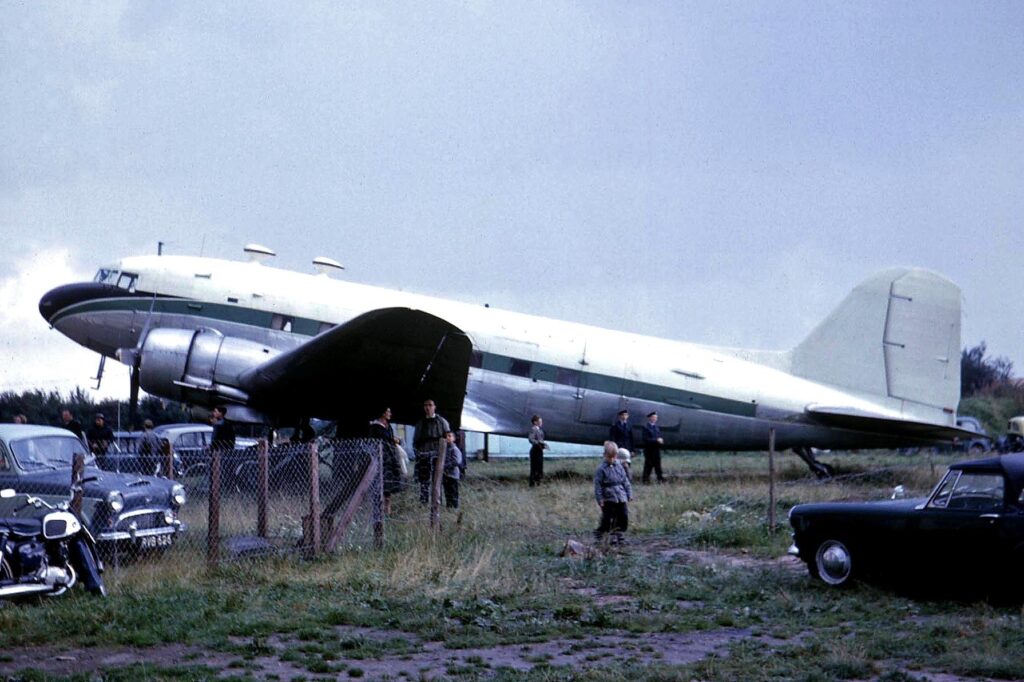
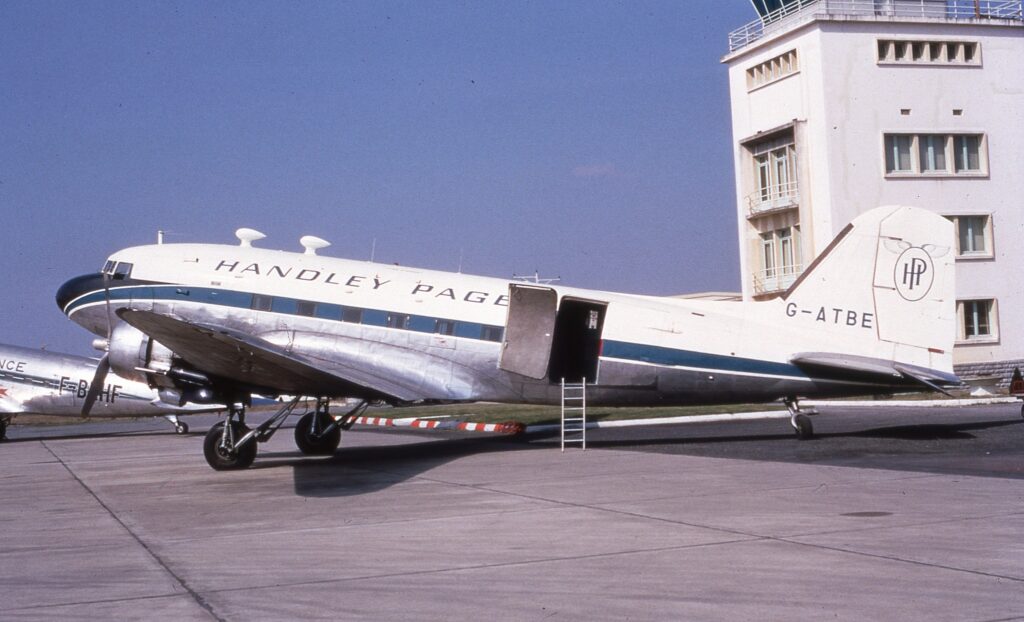
The ‘International Company Holdings’ group of Guernsey comprised International Air Freight and International Air Cargo. The project must have gained some impetus during early 1966 as G-ATBE was flown from Biggin to Luton and, in June of that year, the Dakota was rolled out of Autair’s hangar in a smart red, white and grey scheme with ‘International’ titles and an ‘IAF’ symbol on the rudder. However, operations never started and G-ATBE’s next flight was from Luton to Gatwick and onwards to Ostend on May 26th 1967. She returned to Luton the following day and the return to activity seemed to prompt the sale of the C-47 to Handley Page on June 13th. Handley Page’s pilot John Allam made a familiarisation flight on June 20th and, on July 4th 1967, the Dakota transited to Scottish Aviation’s Prestwick facility to commence a 2-month overhaul. A test flight was carried-out at Prestwick on September 4th and G-ATBE was delivered to Handley Page’s home airfield of Radlett a week later, resplendent in a new livery (1). The aircraft manufacturer had acquired the C-47 to provide logistical support for the development of the feeder-liner turboprop which had just made its first flight in August 1967 and was just about to start an accelerated certification programme over the following winter. While the Dakota had now been fitted with deicer equipment, the lack of which had troubled Aer Turas, the site for certification trials had been moved away from cold northern Europe to Pau in the south of France.
(1) Following her polished metal early colours scheme and the blue cheat line of TAA, G-ATBE was repainted in Nigeria Airways dark green colours following arrival in Africa. Aer Turas maintained an emerald green scheme and adopted the downward curve of the cheat line at the nose. The International colours maintained the cheat line style but its colour changed to red. This didn’t last long and Handley Page reverted to a deep aquamarine shade, not dissimilar to the pre-International scheme. When overhauled by Scottish Aviation in 1969, the green cheatline was swapped for a blue RAF Transport Command-style zig-zag cheatline and this remained with the aircraft for many years. When sold in Canada, North Coast retained the cheatline (and didn’t change HP’s tail crest much either!). Little changed initially when CF-CQT moved to Ilford Riverton Airways but the old Dak got a major repaint in 1979 as Ilford morphed into Air Manitoba. This set the pattern for the Points North colour scheme which followed.
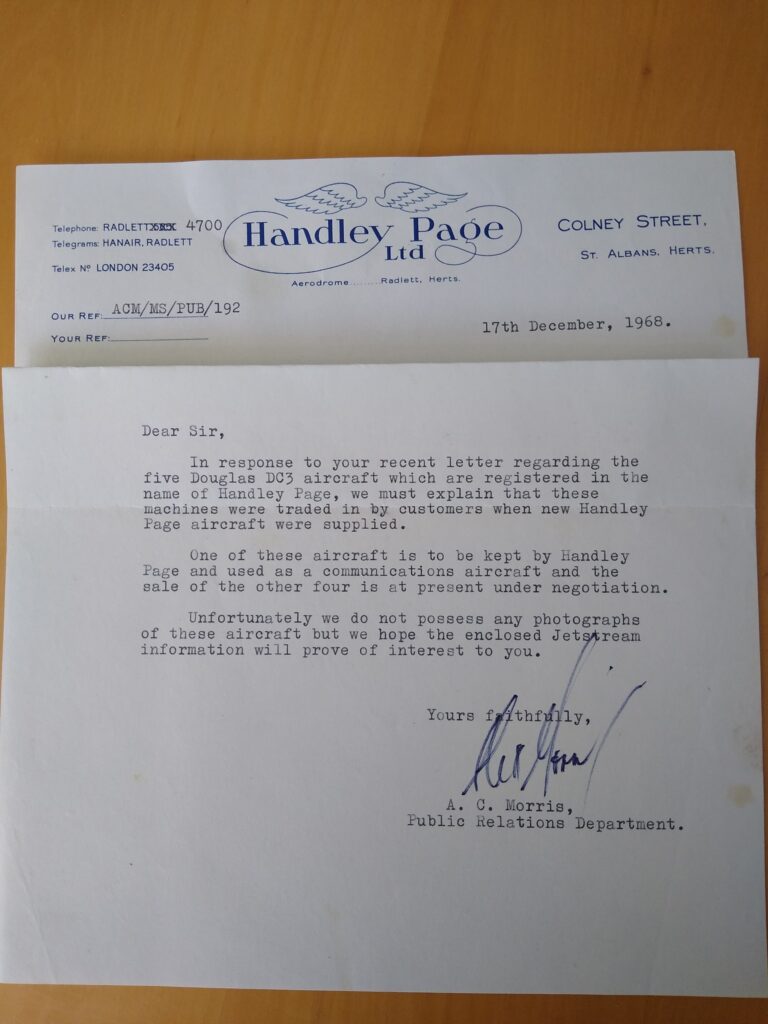
During the winter of 1967/ 68, Handley Page based the two test Jetstreams plus a considerable number of technicians at Pau. G-ATBE ran a twice-weekly schedule between Radlett and France, frequently with customs stops at Luton or Eastleigh, carrying personnel and spares. Although now benefiting from de-icer boots, G-ATBE’s tropical origins may have had implications for the efficiency of the cabin heating. The winter flights from a snowy Britain often had the passengers shivering in arctic conditions while aloft. Typical stop-offs by G-ATBE included Bournemouth Hurn on December 12th 1967 and Eastleigh a year later on December 11th. The Dakota also flew the Jetstream sales team around Europe on various missions which included a visit to the Hanover Air Show in 1968.
The Pau trials were completed in March 1968 and the Jetstreams returned to the UK. G-ATBE became a regular at Prestwick during her time with Handley Page. Scottish Aviation had been signed-up to produce Jetstream wings for Handley Page and the Dakota frequently carried wing components south to the Radlett factory. On January 6th 1969, G-ATBE was the customer for Scottish Aviation when she was booked-in for a Check IV and a repaint. When the Dakota emerged from the maintenance hangar on March 27th 1969, she had been resprayed in the revised Transport Command-style colour scheme and was soon evident at a regular complement of airfields across southern Britain including, surprisingly, Booker/ Wycombe Air Park on April 29th 1969.
In addition to the European trials, the Jetstream was also scheduled to carry-out ‘hot and high’ tropical/ desert trials during 1969 and 1970 and G-ATBE was to provide the logistical support during visits to the Middle East and North/ East Africa. In July 1969, G-ATBE accompanied Jetstream G-ATXJ to Dubai, Khartoum in Sudan and Entebbe in Uganda. While around Entebbe, G-ATBE became the camera ship for a photo shoot involving Jetstream G-ATXJ over Lake Victoria and the Ugandan capital.
Handley Page were also developing the Jetstream 3M for the USAF and G-ATBE accompanied the Garrett-engined prototype G-AWBR to Madrid, Akrotiri in Cyprus and Nairobi. Jetstream G-ATXI was escorted by G-ATBE for a series of trials in Marrakesh but an ominous indication of Handley Page’s financial status had occurred in August 1969 when Barclays Bank appointed a receiver to run the Company’s affairs. The Jetstream’s US sales agents, the International Jetstream Corporation, stepped-in to assure financial backing focused on the development and sale of the Jetstream. A new company, Handley Page Aircraft Ltd, was formed and, on 16th September 1969, G-ATBE was registered to the new entity.
In February 1970, Jetstream G-ATXJ departed for further tropical/ desert trials in the company of G-ATBE. The destinations ranged from Cyprus to Chad, Sudan and Uganda and Handley Page pilots accompanying the operation included John Allam, Harry Rayner and Neil Williams (2). The assembled pilots flew both the Jetstream and the Dakota and, despite the skills and experience on hand, there were several unexpected and eventful happenings, often associated with turbulent air streams over the hot deserts of North Africa. While transiting through the ex-RAF airfield of El Geneina in Darfur Province, Sudan, en route from N’Djamena, Chad, to Khartoum, the Dakota’s take-off run appeared to go on forever. Staggering into the air just short of the threshold, Neil Williams is reported to have quipped that he needed to retract the undercarriage quickly so that he could dive for speed ! (3). On another occasion, both engines died suddenly on a flight between Luxor in Egypt and Akrotiri, Cyprus. The usual robust radial roar was restored when the correct, full, fuel tanks were selected. A return to base was called-for when G-ATBE was flying in the opposite direction, Akrotiri to Luxor, and a rocker gasket blew sending out clouds of oily smoke. Life wasn’t entirely plain-sailing on the ground at Akrotiri either – a February storm in 1970 spun the parked Dakota around, crunching the port aileron into a post. The RAF obliged by freighting-in a replacement aileron. The maintenance team also demonstrated their artwork while the Dakota was in the hangar and it emerged with the appropriate RAF Cyprus badges emblazoned beneath the cockpit window!
(2) Neil Williams was a famous ex-RAF/ RAE test pilot who was renowned for his aerobatic skills. He was also the pilot of HAPS/ Reflectaire’s Lancaster NX611 and further details of his life and career can be found in the ‘Just Jane: Lancaster NX611’ thread.
(3) The quote is taken from the Handley Page Association’s Newsletter as reported in Propliner #75.
Handley Page’s financial status had failed to improve following the involvement of the International Jetstream Corporation and, on February 27th 1970, it was announced that insufficient funds remained for the continuation of operations. G-ATBE was still accompanying the Jetstream trial in N’Djamena when Handley Page formally ceased trading and promptly returned to the UK prior to the sale of Company assets. The liquidation was handled by receivers Cork Gulley and G-ATBE proved to be an easy asset to sell-off: officially sold on March 25th 1970, her transfer to the Canadian register as CF-CQT took place on 1st April 1970. The owner of North Coast Air Services of British Columbia, Jack Anderson, was friendly with ex-Handley Page ferry pilot Bill Bright. While Bright was mostly concerned with maintaining production of the Jetstream via his company, Terravia, he had been happy to recommend G-ATBE to North Coast and they had purchased the Dakota for 7,500 pounds. Jack Anderson was a bush pilot of the old school and he traveled to the UK to collect CF-CQT himself. The Dakota passed through Prestwick on 18th April en route from Coventry to Reykjavik and onwards to Iqaluit, Baffin Island. From there, the C-47 transited steadily westwards to Coral Harbour (on Southampton Island) and across the North West Territories to her new home at Prince Rupert, on the very northern edge of British Columbia.
In the twenty-seven years since emerging from the Long Beach factory, CF-CQT had flown just over 41,500 hours on three continents. Following her return to North America, the C-47 would, amazingly, fly-on for a further twenty-six years, all of them in the demanding environment of northern Canada.
North Coast were definitively bush pilots flying an eclectic mix of, usually, cheap and robust aircraft from Prince Rupert. Cargo and fuel were business staples but the airline would turn its hand to any aviation enterprise. Hunting expeditions, oil exploration and, it was rumoured, ferrying ‘good time girls’ to logging camps were all part of the business plan. During the mid-sixties, Jack Anderson had imported a couple of British cargo carriers, Bristol Freighter CF-UME and scottish Aviation Twin Pioneer CF-STX. Both of these were used extensively on fuel-hauling operations from Prince Rupert into the Interior. The ex-Handley Page Dakota fitted in well with these operations and was also ideal for another NCAS money-spinner: air survey. CF-IQT was fitted with pylon-mounted survey equipment (possibly a magnetometer?) and was used intermittently on oceanographic investigation work from Vancouver between 1970 and April 1974. Another unusual operation performed by CF-CQT was cloud-seeding to make rain around Vancouver’s international airport. At various times North Coast also flew a C-46, a DHC-2 Beaver, a DHC-3 Otter, a Fairchild Huskey, a SeaBee, Cessna 310s, a Cessna Skywagon and a Grumman Mallard. The seaplanes/ floatplanes enabled access along the extensive coastline of northern Canada while the land-based cargo aircraft linked Vancouver and Prince Rupert to towns such as Whitehorse, Prince George and Yellowknife, remote airstrips, logging camps and mining sites. During the summer of 1972, CF-CQT was chartered to Elf Aquitaine for oil exploration work from McKenzie King Island. CGG had carried-out seismic survey work for Elf during 1966 and now the Company wanted to continue exploration. An airstrip had earlier been bulldozed on McKenzie King to accommodate Wardair’s B170 Freighter and Pacific Western DC-4s. CF-CQT was used to haul freight and crew between the island, other outback strips such as Inuvik, Resolute Bay, Coral Harbour, Cambridge Bay and the city of Edmonton, some 2000 miles to the south.
Later in 1972, CF-CQT was positioned south-east to Winnipeg where she was used to haul fish from Island Lake, Manitoba. Jack Anderson and Pete Lazarenko, President of Winnipeg’s Ilford Riverton Airways, both had interests in the fish transport and both operated similar businesses. Ilford Riverton was based in Winnipeg and had been formed in 1960 when the two constituent companies had merged. Seemingly having less success than North Coast, they ran out of finance in the early seventies. The appointed receiver permitted the Company to continue trading under the old name although the holding company became Northland Outdoors of Canada. A restriction was placed on the number of aircraft that could be owned and the fleet already included a Canso flying boat and two C-47s as well as a Beech 18 floatplane, an Otter and two Norsemen (4). Extra capacity was required by Ilford and, unable to add to the fleet, they leased CF-CQT from North Coast in April 1974. Ilford’s Canso, Beech 18s and Otter brought fish cargoes from the Savage Island fish plant to Island Lake and CF-CQT and the other C-47s hauled the fish from there to Winnipeg. Indeed CF-CQT operated to destinations all around Lake Winnipeg and Manitoba, often as part of the airline’s contract to move freight to remote Cree First Nation communities. The Dakota operated from Winnipeg and Gimli as well as the airport at Norway House, the gateway to Cree lands. Freight for the communities was barged up Lake Winnipeg to Norway House, then flown by Dakota to destinations such as Gods Narrows, Oxford House, Cross Lake, Island Lake and Red Sucker.
(4) One of Ilford’s original C-47s was none other than today’s N103NA, ‘Flabob Express’. See the link under D-Day Squadron.
Both North Coast and Ilford Riverton had more than their fair share of accidents and incidents, perhaps indicating what a dangerous business bush flying can be. NCAS had lost their B170 when it sank through ice at Baker Lake in March 1969 (5), Grumman Mallard CF-APA was involved in a fatal crash in March 1974, DHC-2 Beaver CF-FAN had a fatal accident in September 1975 and C-46 CF-CZH crashed in September 1977. Ilford Riverton’s C-47 CF-AII crashed in poor visibility at Fort Severn when inbound from Thunder Bay on a cargo flight in September 1975. The aircraft ripped through the roof of a church and all three on board were killed. It seems almost inevitable that CF-CQT would also sustain damage in this harsh and unforgiving environment and, sure enough, she was involved in a potentially lethal incident on 24th March 1975 when operating with Ilford Riverton from Gimli, Lake Winnipeg. ‘QT had been loaded with 45 gallon drums of fuel and these had been stowed horizontally rather than on their ends. During the take-off run from Gimli, the securing straps broke and seventeen drums rolled to the aft of the cabin. The Dakota immediately adopted a severe tail-down attitude which prompted a low-level stall. Subsequently, the C-47 fell back onto the runway, damaging the port wing, stabiliser and rudder. A swift field repair was effected to enable CF-CQT to be ferried back to Winnipeg but, once there, she remained laid-up waiting for a full restoration to airworthiness. Flying hours totaled 42,240.
(5) NCAS’s B170 CF-UME sank at Baker Lake, 37 miles NW of Prince Rupert. It has recently been located on the lake shore by means of a sonar/ ROV survey.
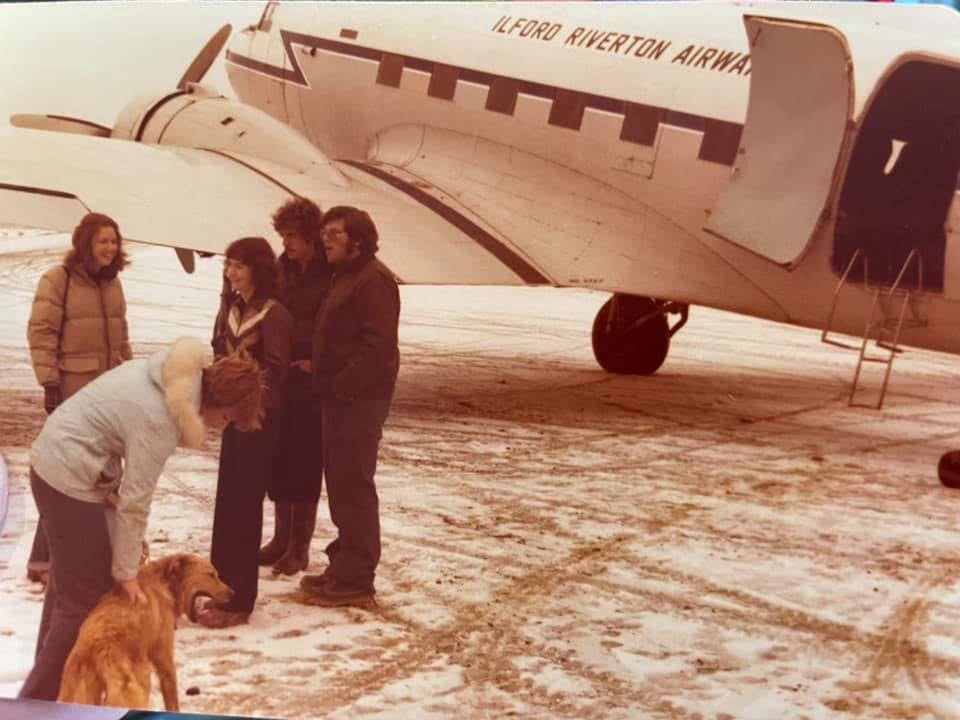
CF-CQT remained parked at Winnipeg in her old North Coast/ Handley Page colours for over three years and it appeared that she would fade away as a spares queen for the rest of the Ilford fleet. However, 1979 saw a change in Ilford Riverton’s fortunes; a fellow Winnipeg-based charter operator, St. Andrews Airways, had gone into administration. St.Andrews had flown Twin Otters, a Saunders ST-27 (stretched Heron), a Found Bush Hawk and Beech 18 floatplanes. They had made efforts to buy a C-47 from Norway and were in direct competition to Ilford Riverton. Their cessation of trading led to a boost in custom for Ilford’s C-47 operations. CF-CQT was restored to airworthiness and a new C of A issued, as C-FCQT, on March 3rd 1979. The C-47 had been owned by Ilford for some time and the old North Coast colours were replaced by a smart red/ white/ blue livery. After a brief spell as a freighter, the C-47 was upgraded to a convertible cargo/ passenger configuration with twenty-seven ex-DC-9 seats installed in nine rows of three. This layout was later amended to the more usual 7 rows of four seats.
C-FCQT variously carried Northland Air and Ilford Riverton titles during the early eighties as the Winnipeg airline returned to profitability. New capital was introduced in 1985 prior to the arrival of turboprop HS748s and it was planned to reorganise the airline under the name of Air Manitoba. C-FCQT was switched to an all-freight configuration following the arrival of the HS748s and, along with C-FADD and C-GWYX, continued to haul fuel and freight between Winnipeg and Gillam, Manitoba. The Northland Air titles had returned in 1987 to avoid offending Ontario sensibilities while shuttling fuel from Pickle Lake to various outlying gravel strips on behalf of hunting lodges. Operations from both Gillam and Pickle Lake involved the fitting of flexible bladder fuel tanks but, by 1990, the use of these had been prohibited and fuel transport required cabin-fitted metal tanks. C-FCQT was fitted with these in April 1990 and was, therefore, committed to fuel hauling. At the end of the 1990 season, she had flown 50,145 hours and, once again, was parked-up at Winnipeg. Ilford Riverton/ Air Manitoba had acquired C-46s and operated one on overseas aid work for three years as from 1994. However, several of the C-47 fleet had departed by 1987 and the remainder were up for sale by 1992. C-FCQT was sold to ‘Buffalo Joe’ McBryan on 25th January 1984 and departed for Red Deer, Alberta. Buffalo Airways didn’t seem to have a definite role in mind for ‘QT (it is featured in Mikey McBryan’s Planesavers Episode 63 and even he doesn’t seem to know what function was anticipated). She was sold to Points North Air on July 21st 1994 and duly departed for her new home in Saskatchewan.
Points North Airport had been opened in 1985 and is on Highway 905, north of La Ronge and about 500 miles north of Saskatoon. It offers freight transit for goods trucked north from La Ronge and, in the nineties, Points North Air’s Otter floatplane then transported food and fuel onwards to remote landings and airstrips such as Uranium City and Fond du Lac. The airline had been founded by brothers Andy, George and Norm Eikl and benefited from the boom in construction in Saskatchewan during the early 1990s. They operated C-47s C-FNWS and C-FNTF as well as Otter C-FAJV but, eventually, all three of these aircraft came to unfortunate ends: the Otter crashed in May 1999, C-FNTF in March of the following year. C-FCQT had been bought from Buffalo to replace C-FNWS (also an ex-Buffalo aircraft) which had sunk through the ice on a lake airstrip during 1994. By 1998, Points North were moving towards replacing the C-47s with Cessna Caravans and C-FCQT was due to be retired first as she had the higher flying hours. As it turned-out, QT did retire in 1998 having flown over 52,000 hours but her life as a spares queen was shortened by the tragic loss of the younger C-FNTF in 2000.
C-FCQT remained in outside storage at points North Landing for many years until she was donated to the Saskatchewan Aviation Museum and Learning Center in 2007. The task of dismantling the C-47 and moving her south to Saskatoon was daunting and it was not until 2015 that four museum staff were able to dismantle the old lady and oversee her loading onto a semi-trailer of Northern Resource Trucking. Today C-FCQT is being restored as a static exhibit at the museum. Having circumnavigated the Globe and flown in Australia, Africa and Europe prior to spending over twenty-five years in the extreme environments of Northern Canada, it will be a well-earned retirement.
Hits: 213