
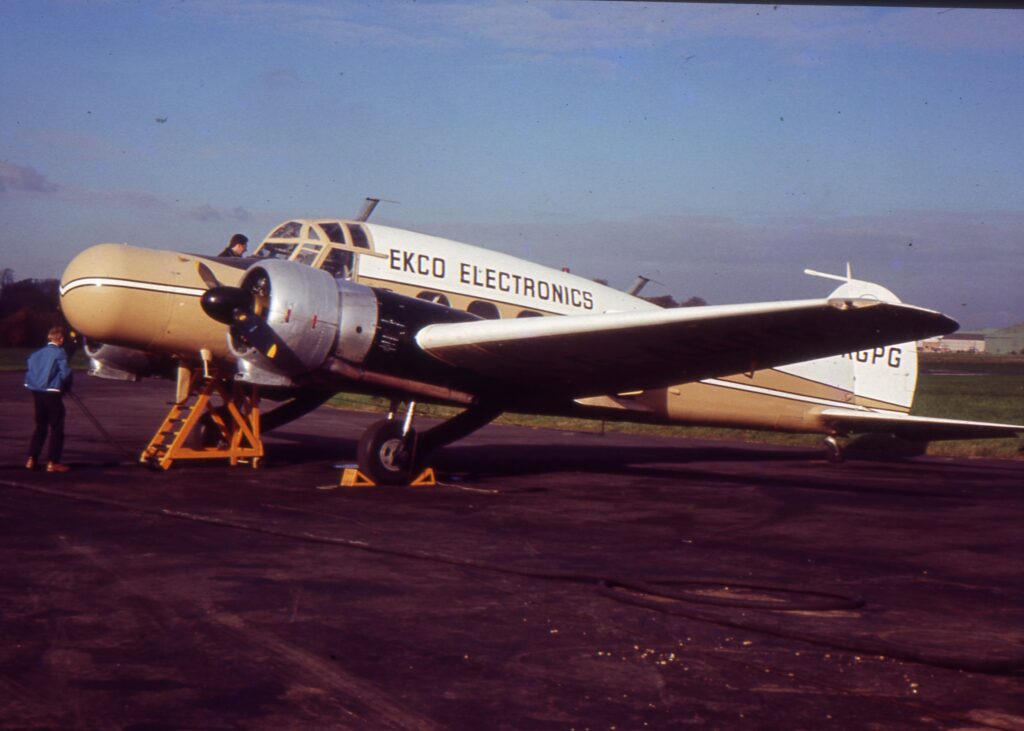
Avro made some great aircraft: the Avro 504K, the Lancaster, Snapshot 8’s subject, the Avro Shackleton, the Vulcan and the featured aircraft, the Avro Anson. Designed as the Avro 652 in response to a specification issued by Imperial Airways in May 1933 for a low-wing monoplane capable of carrying four to six passengers. Avro’s designer Roy Chadwick, who went on to create the Lancaster and the Shackleton, penned a design based upon a Fokker-style of fuselage, twin Cheetah radial engines and a retractable undercarriage. two prototypes were built at Woodford and delivered to Imperial at Croydon on March 11th 1934.
The RAF also showed early interest on behalf of Coastal Command and the 652A emerged fitted with a mid-upper gun turret, upgraded engines, square windows and provision for a small bomb load and a Vickers machine gun mounted alongside the cockpit. The Ministry ordered 174 aircraft in August 1935 and assigned the name ‘Anson’. Production models involved larger tail surfaces and a slight move forwards for the Cheetah IX engines to improve the CofG. The manually-lowered undercarriage was a novelty to the RAF of 1935 and led to a number of wheels-up landings.
By the outbreak of WW2, almost 1000 Ansons had been produced for the RAF and some overseas air arms. The Anson Mk 1 was serving with six RAF squadrons, including 233 Squadron at Leuchars, and four Auxiliary squadrons. An Anson flying from Detling in Kent attacked a U-boat on the third day of the war and, by 1940, Ansons were being fitted with extra machine guns. Ansons proved useful during the Dunkirk evacuation but their replacement in Coastal Command had already begun with the arrival of the Lockheed Hudson. Some Coastal aircraft had been moved to Bomber Command to familiarise crews with multi-engine monoplanes in what became Operational Training Units. A huge order for 1000 Ansons for training operations followed in 1939 to supplement aircraft being moved-on from the reconnaissance units. When the Commonwealth Air Training Plan was initiated in December 1939, it was the Anson which was stipulated as the twin-engine trainer. Aircraft which retained the turret were used for gunnery training.
Further large orders for the Anson benefited the air training schemes in Canada, South Africa, Australia, New Zealand and Rhodesia. Given the hazards of shipping aircraft across the Atlantic, Federal Aircraft Limited was set-up to build the Anson in Canada where modifications would be needed to deal with the winter climate. Nonetheless, over 1500 British-built Anson Mk 1s were shipped to Canada, often without engines. In the frozen North, carburetor heating was added to the Cheetah Xs and some aircraft were fitted with US-built Jacobs L-6MB engines with adapted cowlings. These were designated Anson Mk IIIs to distinguish them from the Canadian-built Anson Mk II which was also fitted with Jacobs radials and had a hydraulically-operated undercarriage. Some Mk II aircraft were supplied to the USA as AT-20s. The Mk IV was built only in small numbers using British airframes and Wright Whirlwind engines. The Mk V was built in Canada, primarily as a navigation trainer, and was fitted with Pratt & Whitney Wasp Junior engines. From the beginning, Canadian-built models had used a moulded plastic-plywood nosecone made by the Vidal method. The Mk V had four of the five fuselage sections made from moulded plastic-bonded plywood with the assemblies joined using bolts or glue. Total Canadian production reached 2,882 aircraft.
In Britain, the Anson was used for training, general transport of Ait Transport Auxiliary pilots and as general squadron hacks. Aircraft built as transports were designated type X, XI and XII and often had strengthened floors and extra doors for stretcher embarkation. The Cheetah engines also evolved and, by the time the XI arrived, aircraft had acquired hydraulically-operated flaps and undercarriages and a perspex nose. The turret had gone and the greenhouse-style of windows had been replaced by square windows.
Following the end of WW2, many of the original Mk Is were sold-off and scrapped, often for bargain prices. Post-war production, however, continued with the XIX which was initially built as a civil third-level airliner to be operated by the Associated Airways Joint Committee. Development since the Mk I had seen the roof lifted and the entrance door positioned lower to make it more attractive for passengers. Better sound-proofing and furnishings were adopted. The RAF liked the new Mk XIX and ordered them as the C.19 Series 1 aircraft, initially with wooden wings, for use as a communications and training aircraft. C19 Series 2 followed with metal wings and some Series 1 C.19s were upgraded (including G-AGPG). Final versions included the T.20, T.21 and T.22 trainers. Production ended in May 1952 with a total of 8,138 aircraft having been built in the UK, another 2,882 in Canada. This was therefore Avro’s largest production run, surpassing the Lancaster. It was another sixteen years before the Anson was finally retired from the RAF in June 1968.
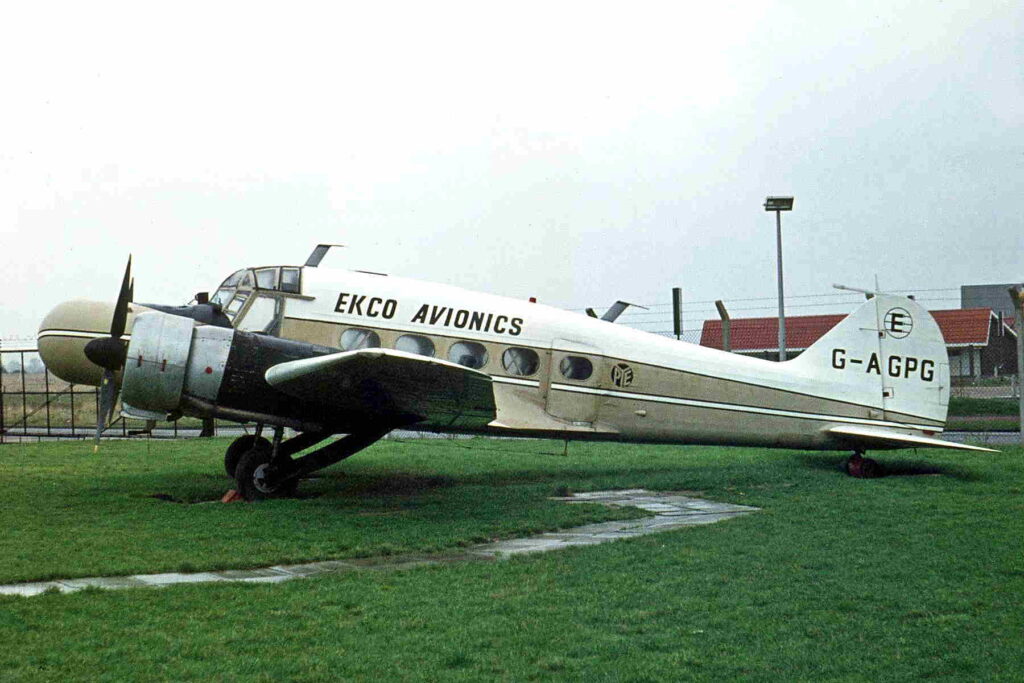
G-AGPG
Construction number 1212 was built at Avro’s Yeadon factory and first flew around July 1945. Originally termed an Anson XII, G-AGPG was re-designated an Avro Nineteen Series 1 on 20th January 1947. This meant that ‘PG originally had wooden wings. CofA #7185 was issued and the aircraft registered to A.V.Roe of Greengate, Manchester on June 15th 1945. Based at Yeadon, the Anson flew as a Company demonstrator and general hack for carrying passengers and light freight between the Company’s airfields at Yeadon, Woodford and Coventry (Armstrong Whitworth). One of the Anson’s earliest tasks was to fly as a demonstrator for Railway Air Services, the immediate predecessor of British European Airways. Avro loaned the company two Ansons and ‘PG was operated on the Renfrew to Stornoway route flown by Scottish Airways. The trial was clearly successful as Railway Air Services ordered a number of Ansons with delivery commencing as from November 1945. When used by Avro. the early colour scheme is described as ‘blue satin’ with the civil registration underlined in the wartime manner. Between September 21st 1948 and April 1st 1949 the Anson was upgraded to a C.19 Series 2 at Woodford. This involved replacing the wooden wings with metal equivalents and the upgrading of the Cheetah 15s to 17s. The colour scheme may have changed at the same time to silver overall with a dark blue window-level cheat line. The Anson was affectionately known as ‘Aggie Paggie’ and was flown by many well-known Avro pilots including the Avro Vulcan test pilot Tony Blackman. During an overhaul in 1957, two new Cheetah 17s were fitted to the Anson: AS 80666 on the port side and AS 80445 on the starboard. These would remain with the Anson for the rest of her flying days. In her sixteen years with Avro, annual utilisation was around 100 hours/ year.
In 1961, Skyways Coach Air became the customer for the first three HS 748s (Avro 748s). G-ARMV began its certification programme from Lympne on November 6th 1971 flown by Skyways pilots between Skyways destination airports. At the end of the month, it returned to Woodford prior to final delivery to Skyways in April 1962. On a visit to Woodford, Eric Rylands, the Skyways Managing Director, is repute to have admired G-AGPG and Avro apparently presented the aircraft to Skyways as a gesture of thanks. G-AGPG was certainly registered to Skyways Coach Air on July 13th 1961 and, twelve days later, transferred to Eric Rylands Ltd with a Lympne Airport address. It was finished in the same red-edged turquoise scheme as the airline’s Dakotas and HS748s and flew some limited operations as the Company hack transferring crew and spares between airports. During the next three years, it flew only 103 hours for Skyways and, for the next three years, it was parked-up at the back of the Skyways hangar with the remnants of the Lancashire Aircraft/ Percival Prospector project.
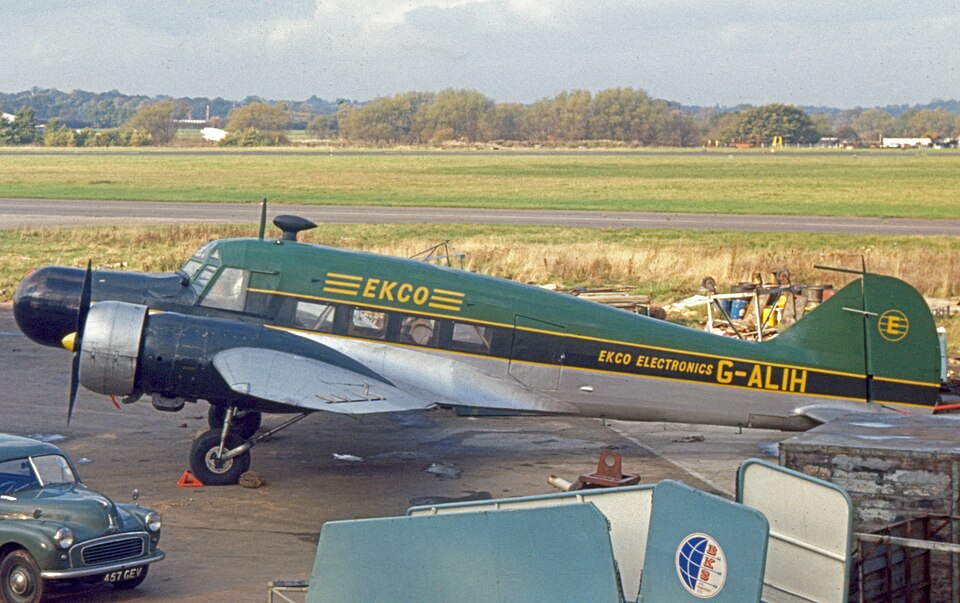
In 1967, G-AGPG was sold to the E.K.Cole company of Southend, producers of Ekco radios as well as avionics items. The Company had previously used G-ALIH, an ex-RAF Anson I previously used by Air Navigation and Trading, Starways and BKS Engineering. ‘IH was registered to Ekco Electronics on July 6th 1954 and was used for testing avionics. It was readily identifiable as it was fitted with a custom ‘long nose’. G-ALIH had wooden wings and a lower roof than G-AGPG and E.K.Cole decided to withdraw it from use following its CofA expiry in September 1967. The purchase of G-AGPG on 20th October 1967 was therefore very convenient and the Anson was delivered to Southend on 26th October.
G-AGPG was overhauled by Aviation Traders at Southend, equipment racks installed and the custom-built electronics-testing nosecone swapped-over from G-ALIH. The Anson first flew in its smart new colour scheme on 26th January 1968 and was displayed in AT (E) Ltd’s Southend hangar on 24th March during the Airport’s 21st anniversary celebrations. It operated for around 120 hours during 1968 and was used for testing the E320 weather radar as part of the Concorde development programme. The heading Snapshot #9 was taken at Luton during 1968, outside the Autair hangar. E.K.Cole was taken-over by Pye Telecommunications and ownership of the Anson officially passed to them on 2nd January 1970. Utilisation of the Anson had dropped during 1970 and ‘PG made her last flight on 24th January 1971 with a total of 1948 flying hours. The CofA expired on 13th February 1971 an the Anson was advertised for sale at 3000 pounds. Ekco had donated G-ALIH to Newark Air Museum and, when G-AGPG found no potential buyers, they agreed to sell her to the nascent Southend Historic Air Museum for a mere 300 pounds.
The Anson was officially withdrawn from use in 1975 following its transfer to the HAM in April 1972, just prior to the opening of the new museum at Aviation Way on May 27th 1972. The Anson was initially displayed inside but was later moved outside into the compound. Here, Southend’s maritime climate began to take its toll on the exhibits and, subsequently, vandals damaged many of the aircraft, including G-AGPG which had its fabric slashed. With falling attendance, the Museum closed in 1983 and the contents were auctioned-off by Phillips on 10th May. The 250 lots garnered a total of 175,000 pounds with G-AGPG sold to Philipe Denis of Romans, France, for a respectable 2800 pounds. However, prior to her collection by the new owner, stormy weather led to further damage when wind ballooned-out the already-ripped fabric. The purchaser back-tracked and the sale was nullified. Eventually, the rather sorry airframe was purchased by Patrick Luscombe of the British Air Reserve who had also bought the HAM Sea Fury. A fabric hangar was erected around the Anson to offer some protection until G-AGPG was dismantled and transported ‘home’ to Lympne in April 1984. By then, it was in very poor condition and, in 1986, it was transported to the Brenzett Aeronautical Museum, also in Kent, where it remained in pieces for the best part of ten years.
In summer 1996, the remains were moved to B.Ae Aerostructures at Chadderton for inspection by the team who were rebuilding Anson G-AHKX, the ex-Strathallan Aircraft Collection Avro C19 series 2 prototype. The intention was to restore ‘PG for static display at Manchester’s Museum of Science & Industry. The airframe was moved to the Aeroplane Collection at Hooton Park in Cheshire and parked inside. Unfortunately, corrosion was noted to have set-in and the subsequent collapse of the hangar didn’t improve the Anson’s health!
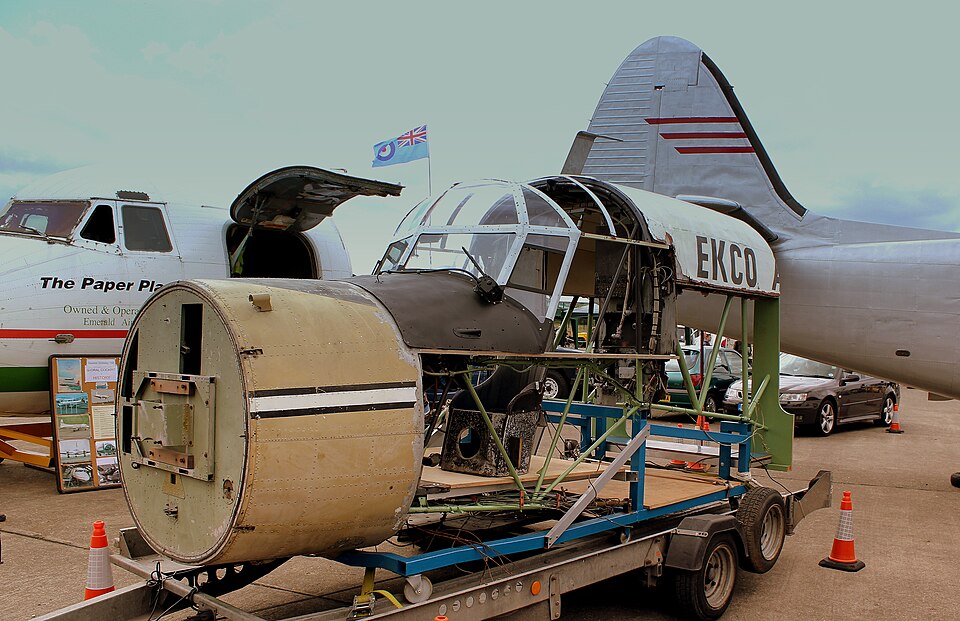
In 2011, the remains were sold to Richard Parr of Retro Aviation at Market Drayton. Some parts were retained to assist with a Mk I rebuild but other sections were sold-off. The cockpit section was purchased by Mike Davey of Newborough, Lancashire, and he commenced a rebuild which included the famous bulbous ‘Ekco Nose’. The restoration was clearly exceptionally demanding given the depths to which the wood/ tube and canvas sections had sunk to. The part-finished cockpit was demonstrated at Newark Air Museum’s cockpit festival day and has since been moved to the Avro Heritage Museum. The centre section is reputedly in Greece where it is due to be combined with parts from Mk 1 AX246.
Port engine AS 80666 was inspected by Chartered Engineer Dave Houghton in January 2012 and he subsequently bought it and moved it to his Lancashire home. He has also purchased an Anson undercarriage from the Montrose Air Station’s TX226 and the two have been combined into an engine nacelle display. The new owner’s father had worked on Ansons during WW2 and his inspiration must have rubbed-off as the engine was coaxed into life on 12th June 2018, some 47 years after it had last run!
The majority of information reproduced here is from three sources:
* A definitive post by Brian Jones on NW Air News forum at https://derbosoft.proboards.com
* The Anson File by Ray Sturtivant, Air Britain Historians, 1988.
* A Key Aero article of 28/9/2028 regarding the engine rebuild.
Other sources included:
* Janes Fighting Aircraft of WW2
* Encyclopedia of World Aircraft edited by David Donald
* British Independent Airlines 1946-76, Tony Merton-Jones.
* Lympne Airfield at War & Peace, Anthony J.Moor, 2014.
* Vampires & Fleas, Alec Brew, 2003.
Hits: 263